
Introduction: Why the Right Office Chair Matters
Choosing the right office chair manufacturer in Ahmedabad is a workplace decision that reaches far beyond colour, upholstery or showroom appearance. An office chair is one of the most frequently used pieces of furniture in a professional environment. Employees may sit for several hours a day, managers may spend long periods reviewing documents or attending virtual meetings, and visitors may use reception or conference seating throughout the working week. Because of this, the chair needs to be evaluated as part of the complete workstation rather than as an isolated furniture product.
The right chair can contribute to a more organised, comfortable and productive working environment when it is matched correctly to the user, desk, task and duration of use. A poor choice can produce recurring complaints about height, back support, armrest position, seat comfort, movement, stability or adjustment. Consequently, a business looking for an office chair manufacturer near me, office chair supplier in Ahmedabad, office chair showroom in Ahmedabad or office chair shop near me should compare construction, ergonomics, product range, service and project capability as carefully as it compares price.
ASCO® by Ambica Industries is an Ahmedabad-based furniture brand with a current range that includes ergonomic chairs, office seating, executive furniture, tables, workstations, storage and other workplace furniture. The company describes itself as a furniture manufacturer serving offices, institutions, commercial environments and residential requirements. Explore ASCO® Furniture for the broader product range.
This guide is designed to help procurement teams, business owners, architects, interior designers, institutions, homeowners and individual office users understand the major office-chair types, ergonomic considerations, materials, mechanisms, procurement factors, local search considerations and maintenance practices that matter before buying.
What Is an Office Chair?
An office chair is a seating product intended for desk-based work and other professional activities. Unlike simple fixed seating, an office chair may incorporate a swivel base, castors, height adjustment, tilt or recline, armrests, lumbar support and other features that allow the user to adjust the relationship between the body, chair and desk.
Not every chair needs every adjustment. A short-duration visitor chair serves a different purpose from an ergonomic task chair used for a full working day. An executive high-back chair can be appropriate for a senior cabin, while a compact mesh task chair may be more suitable for an open workstation. This is why product category and user application should be identified before the purchase decision.
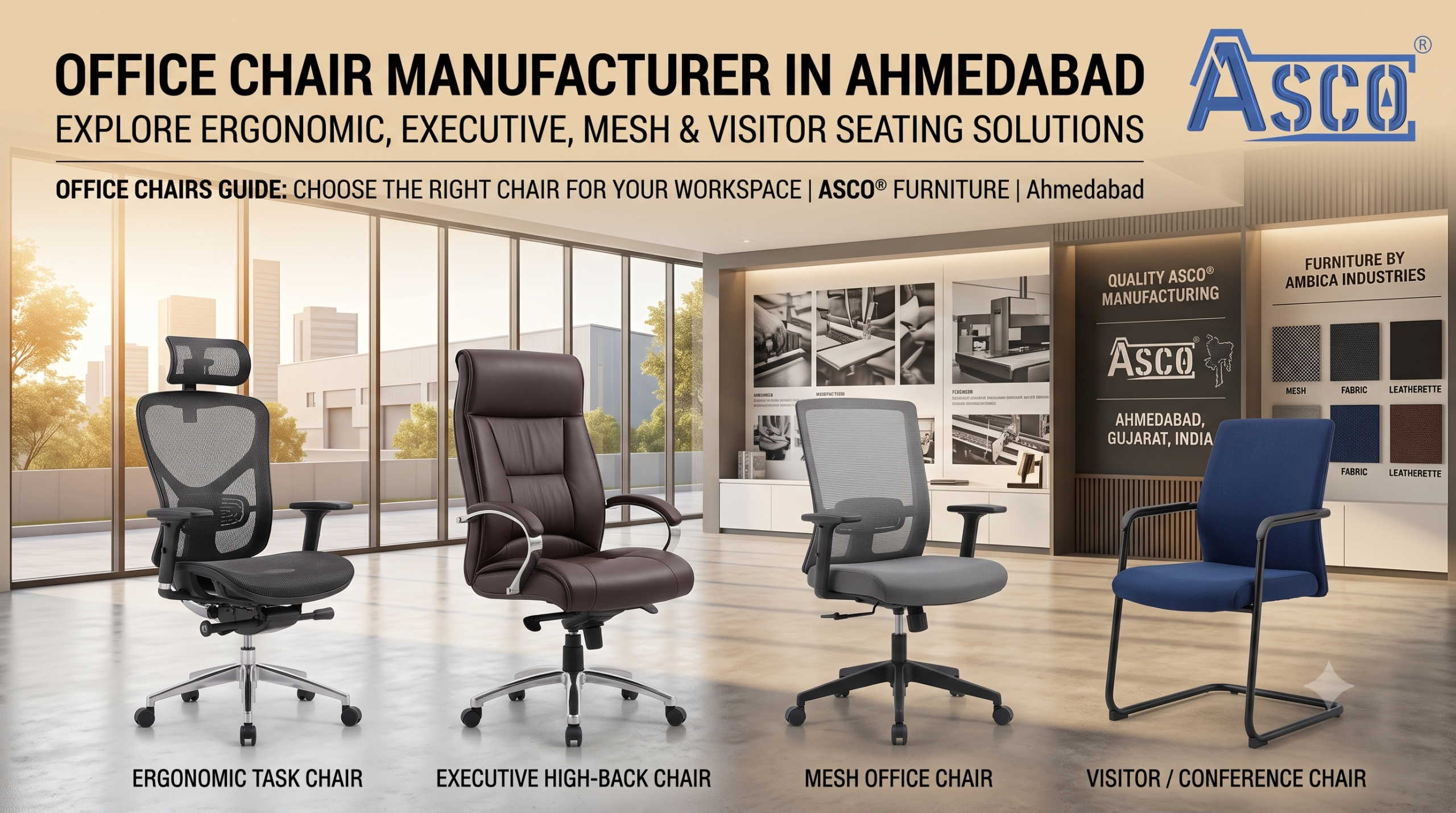
Typical office-chair categories include:
- Ergonomic task chairs
- Executive high-back chairs
- Mesh-back chairs
- Mid-back chairs
- Low-back chairs
- Visitor chairs
- Reception chairs
- Conference and boardroom chairs
- Home-office chairs
- Training and institutional chairs
- Height-adjustable and multi-tilt chairs
Why Office Chair Selection Needs Proper Planning
A chair can look excellent on a showroom floor and still be unsuitable for a particular employee or department. Planning should begin with the use case. Ask how many hours the chair will be used, what type of desk it will be paired with, whether the user needs movement within the workstation, whether different people will share the chair, what maintenance environment applies and how many chairs are being procured.
For a small purchase, a user can test several chairs personally. For a 100-seat or 500-seat project, the process should be more structured. A procurement team can shortlist two or three models, request samples, test them with different users and then approve a standard specification. This can reduce the risk of ordering a large quantity of chairs that later generate complaints or replacement requests.
- User height and body-size variation
- Daily sitting duration
- Desk and workstation dimensions
- Lumbar-support requirement
- Seat depth and width
- Armrest requirement
- Backrest height
- Recline and tilt needs
- Flooring and castor requirements
- Climate and ventilation
- Cleaning and maintenance capacity
- Budget and order quantity
Office Chair Types Explained
Ergonomic Task Chairs
Ergonomic task chairs are generally intended for extended desk-based work. Depending on the model, they may provide height adjustment, lumbar support, armrests, tilt control, recline or a breathable mesh back. Their design should be evaluated in relation to the desk and the user rather than by the number of advertised features alone.
Executive High-Back Chairs
Executive chairs are commonly used in director cabins, manager offices and senior work areas. A taller backrest, substantial cushioning, premium-looking upholstery and additional recline can suit these settings. Even so, executive appearance should not replace practical support, stable construction and comfortable adjustment.
Mesh Office Chairs
Mesh chairs use a breathable woven backrest to improve airflow. They can be useful in warmer climates or offices where users remain seated for long periods. Buyers should inspect mesh tension, frame attachment, lumbar support and the quality of the seat cushion rather than assuming all mesh chairs offer the same support.
Mid-Back Office Chairs
Mid-back chairs offer a balance between support and compact proportions. They are often suitable for general workstations, conference areas or secondary work positions. The correct height depends on the user and the desk setup.
Low-Back Office Chairs
Low-back seating can work in areas where users sit for shorter periods or where a lighter visual profile is desired. For full-day computer work, buyers should ensure the backrest still provides enough support for the actual user.
Visitor Chairs
Visitor chairs are intended for shorter-duration seating in cabins, reception areas and meeting spaces. They often use fixed frames rather than complex ergonomic mechanisms. Stability, appearance, cleanability and seat comfort are important selection factors.
Conference and Boardroom Chairs
Conference chairs should remain comfortable through meetings that may last longer than a quick discussion. They may use mid- or high-back profiles, armrests and fixed or limited-adjustment designs. The chair should be coordinated with the conference table height.
Home-Office Chairs
Home-office chairs need to provide professional support while fitting into smaller residential rooms. Compact ergonomic chairs with adjustable height and practical upholstery can be suitable when the chair is used for remote work every day.
Institutional and Staff Chairs
Educational institutions, healthcare offices and other organisations often require durable seating that can be used by multiple staff members. Low maintenance, stable construction and repeatability across a large order can be more important than premium executive styling.
Height-Adjustable and Multi-Tilt Chairs
Advanced adjustment mechanisms can be useful where several users share a workstation or where employees want to change posture during the day. Buyers should understand which adjustments are genuinely useful and whether the mechanism is easy to operate and maintain.
Office Chair Ergonomics: What Should Buyers Look For?
Ergonomics is not a single feature that can be checked by reading a product name. It is the relationship between the chair, the user, the desk, the screen, the keyboard and the work pattern. A suitable office chair should allow the user to establish a comfortable working position without excessive reaching, shoulder elevation or awkward knee and foot placement.
| Feature | Why It Matters |
|---|---|
| Adjustable seat height | Helps the user position the chair so the desk, legs and feet work together. |
| Lumbar support | Supports the lower-back region and can help the user maintain a more natural seated position. |
| Seat depth | Should allow the user to sit back comfortably without creating excessive pressure behind the knees. |
| Armrests | Can support the arms and reduce unnecessary shoulder loading when correctly adjusted. |
| Tilt or recline | Allows controlled posture changes instead of forcing one rigid sitting position. |
| Breathable backrest | Can help reduce heat build-up during prolonged seating, especially in warm workplaces. |
| Stable five-point base | Provides a practical foundation for swivel and rolling movement. |
| Smooth castors | Support controlled movement without unnecessary dragging or abrupt resistance. |
A useful rule is to test the chair at the actual desk height. A chair that feels comfortable in a showroom can behave differently when a large desk, fixed-height work surface, monitor arrangement or armrest clearance is introduced. The complete workstation should therefore be tested wherever possible.
Seat Height, Seat Depth and Desk Compatibility
Seat height should allow the user to work at the desk without raising the shoulders or allowing the legs to dangle. Seat depth should provide sufficient support without forcing the user too far forward. These elements are often overlooked when buyers focus only on the backrest.
Desk height is equally important. If a desk is fixed and a chair is very high, the user may have to raise the shoulders to reach the keyboard. If the chair is too low, the working surface may feel unusually high. Adjustable chairs can provide additional flexibility, but they do not eliminate the need for sensible desk dimensions.
When several users share the same workstation, a wide range of chair adjustment can be more useful than one fixed specification. This is particularly relevant for hot-desking, training environments and offices with frequent staff rotation.
Lumbar Support and Backrest Design
Lumbar support is intended to support the lower back region. It may be built into the shape of the backrest, added as cushioning or provided through an adjustable mechanism. The right arrangement depends on the user and the chair design.
A high backrest can provide a greater sense of support, but height alone does not guarantee good ergonomics. The backrest should allow the user to sit comfortably without restricting natural movement. Likewise, a mesh back can feel breathable while still needing correct frame tension and lumbar shaping.
For procurement teams, the best test is practical: have representative users sit in the sample chair for enough time to identify pressure points, adjustment problems and support issues before approving a large order.
Armrests: Fixed, Adjustable and Why They Matter
Armrests can support the forearms and reduce the amount of time that the shoulders and neck must remain unsupported. However, an armrest that is too high can cause the shoulders to lift, while one that is too wide can interfere with the desk.
Adjustable armrests can be useful when user heights vary. Fixed armrests can work well where the desk and chair specification are standardized. For compact spaces, a slim or armless profile can sometimes make more sense than a large chair with bulky arms.
Backrest Height: Low, Mid and High Back
Backrest height should match the task. Low-back seating can work for brief interactions, mid-back chairs are common for general office use and high-back chairs are often associated with executive or more supportive applications. The correct category depends on the user and duration of use, not simply the visual impression of the chair.
High-back executive chairs can also occupy more visual and physical space. In a compact cabin, a very bulky chair can make movement difficult. In an open office, standardized mid-back ergonomic chairs may be a more practical solution.
Chair Mechanisms: Tilt, Recline and Multi-Tilt
Chair mechanisms determine how the backrest and seat respond to movement. Basic chairs may offer height adjustment and a simple tilt action. More advanced mechanisms can support controlled recline, multi-position locking or synchro movement.
| Mechanism / Feature | Typical Purpose | Buying Consideration |
|---|---|---|
| Height adjustment | Changes seating height | Check smooth operation and stability. |
| Tilt lock | Locks the chair at a selected angle | Useful when the user prefers a fixed working position. |
| Free tilt | Allows controlled movement | Useful for users who change posture frequently. |
| Synchro mechanism | Coordinates seat and back movement on selected models | Check adjustment simplicity and serviceability. |
| Multi-tilt mechanism | Provides multiple recline positions | More features are not automatically better; choose what users will actually use. |
For large office orders, mechanism quality matters because repeated adjustment can expose weak components quickly. Procurement teams should test the lever, movement, resistance and locking action on a sample before standardising a model.
Gas-Lift Cylinders and Office Chair Height Adjustment
The gas-lift cylinder is the component that normally controls seat-height adjustment on a revolving office chair. Users interact with it frequently, so smooth operation and appropriate load rating matter. A chair that slowly drops, suddenly moves or becomes unstable should be inspected rather than ignored.
The cylinder should be treated as part of the complete chair system. A strong base with a poor cylinder can still create a poor user experience. Similarly, a quality cylinder cannot compensate for a weak base, unsuitable castors or poor frame construction.
Base, Castors and Chair Stability
The base supports the chair and transfers load through the castors. A five-point base is commonly used because it provides a broad support footprint. Bases may be made from reinforced polymers, nylon or metal depending on the chair.
Castor selection should match the flooring. A chair used on carpet, tile, vinyl or a hard surface can behave differently depending on the wheel design. Where an office uses expensive flooring, buyers should also consider whether the castor type is appropriate for that surface.
- Check for wobble while seated.
- Roll the chair across representative flooring.
- Inspect the connection between the base and cylinder.
- Look for loose castor fittings.
- Test swivel movement without excessive resistance.
Office Chair Materials
Office chairs can combine several materials rather than relying on one construction material. A single chair may use a steel or reinforced polymer frame, mesh or fabric on the back, foam in the seat, PU or leatherette upholstery, nylon or metal components in the base and engineered plastics around the mechanism.
| Material | Common Use | Key Consideration |
|---|---|---|
| Mesh fabric | Backrest | Breathability, tension and attachment quality. |
| Fabric upholstery | Seat and/or back | Comfort, cleaning and stitching quality. |
| PU leather / leatherette | Executive seating | Appearance, wipe-clean surface and long-term finish. |
| High-density foam | Seat cushion | Compression recovery and comfort under daily use. |
| Reinforced nylon / polypropylene | Base, armrests and structural components | Weight, durability and moulded consistency. |
| Steel | Frames, supports and selected bases | Strength, welding, corrosion protection and finish. |
| Chrome / metal finish | Selected bases and components | Appearance and surface protection. |
Which Material Is Best for Office Chair?
There is no single material that is best for every office chair. A breathable mesh back may be appropriate for a warm open office, while an upholstered executive chair may suit a management cabin. Steel and reinforced polymer components are commonly used where structural support is needed, while foam and upholstery determine much of the seating feel.
The better question is whether the complete combination of materials is suitable for the intended application. Buyers should compare frame, base, mechanism, seat construction, upholstery and finishing together.
Which Wood Is Best for Office Chair?
Most ergonomic swivel office chairs do not rely on wood for their primary structural mechanism because height adjustment, swivel movement and rolling require other engineering components. Wood can appear in fixed visitor or reception chairs where a decorative wood frame is part of the design. For task, ergonomic and executive revolving chairs, buyers normally focus on the base, mechanism, frame, mesh, upholstery and seat construction instead.
Office Chair Comfort: What Should You Actually Test?
Comfort is subjective, which is why sitting on a chair matters more than looking at a product photograph. A useful test should involve the user’s actual posture, desk, screen and working pattern. Sit back, adjust the height, test the armrests, lean into the backrest and check whether the thighs are supported without pressure behind the knees.
For procurement, include different users in sample testing. One person may prefer a softer seat while another may prefer firmer support. Height differences can also reveal whether the adjustment range is sufficient. A sample-testing record can help a team make an evidence-based decision rather than relying on the most senior person’s preference.
Office Chair for Long Working Hours
Chairs used for eight-hour or longer workdays need more attention than occasional-use visitor seating. Look at adjustment range, lumbar support, seat construction, backrest ventilation, mechanism durability and compatibility with the workstation. Employees who alternate between calls, typing, reading and meetings may also benefit from controlled posture changes.
The objective should not be to make the chair as complicated as possible. It should be to provide the adjustments that the user can understand and use consistently. A simple, well-built ergonomic chair may provide more practical value than an advanced chair with mechanisms that staff never adjust correctly.
Office Chair for Small Offices and Home Workstations
Small offices and home workstations often have limited circulation space. A compact ergonomic chair may be more suitable than a large executive chair, especially where the desk is positioned close to walls or storage.
- Choose a chair footprint that fits the desk area.
- Check armrest width against the desktop.
- Ensure the chair can roll back without hitting a wall or cabinet.
- Allow enough turning space for the user.
- Select practical upholstery that can be maintained in a home environment.
Office Chairs for Corporate Workstations
Corporate offices often require hundreds of chairs with consistent appearance and specifications. Ergonomic task chairs are commonly considered for open-floor workstations because they support daily computer work without the bulk of executive seating.
For a corporate office, procurement teams should define a standard model or a small number of approved models. This can simplify ordering, replacement, staff movement between departments and spare-parts planning. A manufacturer with a broader office-furniture range can also help coordinate chairs with desks, workstations and storage.
Office Chairs for Executive Cabins
Executive cabins require a different balance of appearance, comfort and functionality. A high-back executive chair can reinforce the visual character of the cabin, while a matching executive table provides the working surface.
Even in a premium cabin, the chair should not be selected purely for its look. Recline resistance, seat height, back support, armrest position, base stability and movement should still be tested. Visitors sitting opposite the desk also influence the overall furniture layout.
Office Chairs for Conference and Meeting Rooms
Conference seating should be comfortable enough for meetings while fitting beneath and around the conference table. Armrests may improve comfort but can also affect the distance between chairs. A bulky executive chair may reduce the number of participants that fit around a table.
For boardrooms, visual consistency is often important. The chair finish should coordinate with the table, room architecture and other furniture without sacrificing comfort.
Office Chairs for Reception and Visitor Areas
Visitor chairs usually involve shorter sitting periods than employee workstations. Their priorities often include professional appearance, stability, easy maintenance and a compact footprint. Reception areas also experience frequent visitor turnover, so the upholstery and frame should be practical for repeated use.
Office Chairs for Co-Working Spaces
Co-working environments can have high seat turnover. Different people may use the same chair throughout the day or week, so adjustment range, easy cleaning, durable mechanisms and repeatable specifications matter. Furniture should also work with hot-desking, shared desks and flexible meeting areas.
Office Chairs for Call Centres and BPO Workspaces
Call centres and BPO environments can require high-density seating for employees working for long periods. A chair specification should consider prolonged use, floor layout, desk dimensions, castor movement, cable management and the ability to maintain a large fleet of chairs.
For bulk projects, the question is less about finding a fashionable chair and more about choosing a repeatable product that employees can use comfortably while the organisation maintains consistent procurement and service processes.
Office Chairs for Educational Institutions
Schools, colleges, training centres and institutional offices can require several kinds of seating. Staff rooms may need office chairs, administrative areas may use task seating, computer rooms may require chairs matched to fixed desks and reception areas may use visitor seating.
Institutional buyers should prioritise durable construction, easy maintenance and consistent availability for replacement orders. Where the institution is furnishing several rooms, one manufacturer may be able to coordinate chairs with tables, benches, storage and other furniture categories.
Office Chairs for Hospitals and Clinics
Healthcare facilities also contain administrative workplaces. Accounts, HR, billing, procurement, medical administration, records and IT areas can use conventional office chairs and workstations. Reception and waiting areas may use separate visitor and waiting seating.
The office furniture selected for these areas should be easy to clean and should fit the specific room layout. The manufacturer should be asked for the exact product specification before a large project order is approved.
Office Chairs for Government and Institutional Offices
Government and institutional offices may require large quantities of standardized seating. Procurement can place greater emphasis on specification compliance, budget control, documentation, quantities and delivery schedules.
A local manufacturer can be useful when a project needs factory communication, physical sample review, repeat production and coordinated delivery. Buyers should still verify the exact procurement requirements of their organisation and the applicable purchasing route.
Office Chairs for Manufacturing and Industrial Offices
Manufacturing companies often maintain offices next to factories, warehouses or production facilities. These offices may need seating that can tolerate practical conditions while remaining comfortable for administrative work. Accounts, HR, engineering, planning, procurement and management departments may have different chair requirements.
In industrial environments, practical maintenance can be particularly important. Buyers should consider dust exposure, flooring, cleaning schedules, visitor traffic and the distance between office and production areas.
Office Chairs for Home Offices and Remote Work
Home working has made office chairs a residential furniture purchase as well. A home-office chair should support long periods of screen-based work while fitting into the available room. Compact dimensions, quiet castors, practical upholstery and adjustable height can be useful features.
The user should also consider desk height, monitor position, room lighting and cable arrangement. An ergonomic chair cannot correct an entire workstation that is poorly arranged.
Office Chair Manufacturer vs Office Chair Supplier
A manufacturer is directly involved in producing the furniture, while a supplier may manufacture, distribute, resell or source products from several companies. Neither model is automatically better. The appropriate route depends on the purchase.
For one chair, a local store may be sufficient. For 100 or 500 chairs, a direct manufacturer may offer clearer communication about specifications, quantity, production, customization and delivery. Businesses should ask who actually makes the product and who is responsible for warranty or replacement support.
Office Chair Manufacturer Near Me
The phrase office chair manufacturer near me signals strong local commercial intent. However, distance alone should not determine the supplier. Compare manufacturing capability, product range, quality, sample availability, bulk capacity, delivery, installation and service.
For Ahmedabad buyers, a local manufacturer and showroom can provide a practical opportunity to test chairs, compare models and discuss bulk specifications in person. ASCO® / Ambica Industries identifies its operation at Narol, Ahmedabad, Gujarat. Contact ASCO® Furniture for current product and project enquiries.
Office Chair Showroom in Ahmedabad
A showroom allows buyers to experience a chair rather than judging it from a photograph. During a showroom visit, spend enough time in the chair to test height, back support, armrests, recline and movement. If the purchase is for multiple employees, bring representative users when practical.
For larger projects, a showroom visit can also be combined with a factory discussion. This makes it easier to understand whether the displayed chair can be supplied consistently at the required quantity.
Office Chair Factory in Ahmedabad
A factory visit can reveal aspects that finished products do not show. Procurement teams can look at production capability, materials, fabrication, assembly, finishing, inspection, packaging and dispatch processes.
This does not mean every factory visit guarantees quality. It simply gives the buyer more information when assessing a manufacturer. The most useful approach is to compare the observed manufacturing process with the exact product specification being quoted.
Office Chair Supplier in Gujarat
Ahmedabad is a major commercial and manufacturing centre in Gujarat, and businesses across the state may require office seating for new offices, expansions, renovations and replacement programmes. Potential customer locations include Gandhinagar, Vadodara, Surat, Rajkot, Bharuch, Ankleshwar, Vapi, Mehsana, Anand, Nadiad, Bhavnagar, Jamnagar, Junagadh and other cities.
A supplier serving Gujarat should be evaluated for transportation and installation coverage as well as product quality. For large orders, the delivery plan should be agreed before production begins.
Office Chair Supplier Across India
Businesses with offices in several Indian cities may benefit from standardised chair specifications. One manufacturing relationship can simplify repeat orders, replacement parts, colour matching and future office expansion.
Before using a single supplier nationwide, confirm the manufacturer’s capacity to coordinate delivery, installation and service outside its home region. A consistent product specification should be documented so later purchases do not drift into different materials or mechanisms.
Office Chair Materials and Upholstery Selection
Upholstery affects appearance, touch, cleaning and long-term wear. Mesh can offer airflow. Fabric can provide a broad range of textures and colours. PU leather or leatherette can give an executive appearance and can be convenient to wipe clean. The correct choice depends on application, user preference and maintenance conditions.
High-traffic areas may benefit from easier-clean materials, while executive cabins may prioritise appearance and a premium visual finish. Offices should also consider how direct sunlight, cleaning chemicals and humidity may affect the chosen upholstery.
Office Chair Colour and Corporate Branding
Chair colour can contribute to a consistent office identity. Corporate projects sometimes standardise upholstery across departments or use different colours to distinguish areas. A manufacturer may be able to discuss available upholstery and finish options.
Colour should not override construction and comfort. The same office can maintain a professional appearance through consistent chair models, matching finishes and coordinated desks without needing excessive variation in every department.
Office Chair Specifications: What Should Be Documented?
When comparing manufacturers, specification sheets reduce ambiguity. A useful office-chair specification can include the product name, type, brand, material, construction, upholstery, base, mechanism, adjustment features, dimensions, application, manufacturer and manufacturing location.
| Specification | What to Document |
|---|---|
| Product Name | Exact model or product family. |
| Product Type | Ergonomic, executive, mesh, visitor, conference or other type. |
| Brand | ASCO® or the quoted brand. |
| Seat Construction | Seat material, cushioning and upholstery. |
| Backrest | Mesh, fabric, leatherette or other material and support type. |
| Mechanism | Height, tilt, recline, lock or other adjustment features. |
| Base | Material and construction. |
| Castors | Type and suitability for the flooring. |
| Dimensions | Published dimensions where supplied by the manufacturer. |
| Application | Workstation, executive cabin, conference room, visitor area or other application. |
| Warranty | Written terms and applicable components. |
| Manufacturer | Ambica Industries / ASCO® where applicable. |
| Manufacturing Location | Ahmedabad, Gujarat, India, where applicable. |
Precise technical numbers should be taken from the actual product specification or quotation. Do not assume that two chairs with similar names have identical dimensions, load ratings or mechanisms.
How to Check Office Chair Quality Before Buying
Check the Base and Castors
Inspect the base for cracks, distortion or loose connections. Roll the chair on the actual flooring where possible.
Check the Gas-Lift
Raise and lower the chair several times. Look for smooth operation without unexpected movement.
Check the Seat
Sit for long enough to assess pressure distribution, seat depth and cushion recovery.
Check the Backrest
Lean back and test support, tension and movement. Check the attachment between the backrest and frame.
Check the Armrests
Test stability and adjustment. Make sure they do not interfere with the desk.
Check the Mechanism
Operate each adjustment. Controls should be understandable and accessible.
Check Upholstery
Inspect stitching, seams, mesh tension and surface finish.
Check Overall Stability
Use the chair normally and check for rocking, looseness or unusual sound.
Procurement tip: Approve a finished sample before ordering a large quantity whenever the project scale justifies formal sample evaluation.
Why Cheap Office Chairs Can Become Expensive
A low purchase price can look attractive when multiplied across a large office, but the procurement team should also consider replacement frequency, repair costs, downtime and service. If a chair develops a failed cylinder, broken base, sagging seat or loose armrest shortly after installation, the business may pay additional costs that were not visible in the original quotation.
The better comparison is total value: purchase price + expected working life + maintenance + replacement + service. A chair that is modestly more expensive but performs consistently for longer may be the more economical option.
Bulk Office Chair Procurement
Bulk procurement changes the buying process. The organisation is no longer choosing one chair; it is defining a standard that may affect an entire floor, branch or network of offices. Consistency becomes critical.
- Define the user groups and chair categories.
- Prepare a quantity-based BOQ.
- Shortlist manufacturers and models.
- Request samples or product demonstrations.
- Test the chairs with representative users.
- Finalize the specification and commercial terms.
- Approve the sample and production standard.
- Coordinate delivery and installation.
- Inspect the delivered quantity and quality.
- Retain the approved specification for future replacement orders.
Office Chair BOQ for Corporate Projects
| Item | Chair Category | Quantity | Application | Specification Notes |
|---|---|---|---|---|
| 1 | Ergonomic Task Chair | Employee workstations | Define lumbar support, arms, mechanism and base. | |
| 2 | Executive Chair | Director / management cabins | Define back height, upholstery and recline. | |
| 3 | Conference Chair | Meeting room | Coordinate height and armrest clearance with table. | |
| 4 | Visitor Chair | Reception / cabins | Prioritise stable construction and practical upholstery. | |
| 5 | Home-Office Chair | Remote / hybrid users | Compact ergonomic profile and appropriate adjustment. | |
| 6 | Institutional Chair | Staffrooms / shared spaces | Durability and repeatability across large quantities. |
A consistent BOQ allows different manufacturers to quote against the same requirement. This is one of the simplest ways to improve procurement comparability.
Office Chair Procurement Timeline
- Needs assessment: identify departments, user groups and quantities.
- Manufacturer shortlist: compare product specifications, range and manufacturing capability.
- Sample review: physically test representative chairs.
- Commercial comparison: review price, taxes, delivery, installation and warranty.
- Approval: freeze the final product specification.
- Production: allow the agreed manufacturing lead time.
- Delivery: coordinate site access and unloading.
- Installation: assemble and position chairs.
- Final inspection: check quantity, condition and specification.
- Post-installation: retain service and warranty records.
Office Chair Warranty and After-Sales Service
Warranty terms differ by manufacturer and product. The important issue is clarity. Before approving an order, obtain written information about the warranty period, covered components, exclusions and service process.
Ask whether the warranty covers the base, gas-lift cylinder, mechanism, upholstery and manufacturing defects. Also ask how service requests are logged and whether replacement components can be supplied when appropriate.
Office Chair Maintenance for Long Life
- Clean upholstery regularly: use a method suited to mesh, fabric or leatherette.
- Inspect the gas-lift: check for abnormal movement or loss of height.
- Clean castors: remove dust and hair that may affect rolling.
- Check fasteners: inspect visible connections around arms and base.
- Use the recline mechanism correctly: avoid forcing adjustment controls.
- Protect upholstery: limit unnecessary direct sunlight and unsuitable cleaning chemicals.
- Repair early: address loose parts before they become structural problems.
Seasonal Office Chair Care in Gujarat
Ahmedabad and other parts of Gujarat experience hot summers and a humid monsoon period. Environmental conditions can affect upholstery, metal finishes, dust accumulation and cleaning routines.
During the Monsoon
- Wipe moisture from metal surfaces.
- Check areas around the base for early surface corrosion.
- Clean castors and flooring regularly because wet-season dirt can accumulate quickly.
- Keep fabric and mesh clean and adequately ventilated.
During Summer
- Protect leatherette from prolonged direct sunlight.
- Maintain ventilation around the chair.
- Clean dust from mechanisms and castors.
- Review high-use chairs for early signs of cushion or mechanism wear.
Office Chair Sustainability and Lifecycle Value
A durable office chair can contribute to a more responsible furniture lifecycle because longer service reduces the frequency of replacement. Businesses can also consider whether the manufacturer supports repair or part replacement for components such as castors, cylinders or upholstery.
Sustainability should be evaluated practically. Instead of relying only on broad environmental claims, ask what materials are used, how durable the chair is, what can be repaired, how replacement parts are handled and how the product fits into the organisation’s long-term procurement strategy.
Office Chair Standardization Across an Organisation
Standardization can simplify procurement and administration. When one or two approved chair specifications are used across an organisation, replacement orders are easier because the buyer already knows the dimensions, upholstery, mechanism and spare-part requirements.
- Simpler maintenance and spare-parts management
- Better visual consistency across departments
- Easier comparison of replacement quotations
- Faster employee onboarding and workstation setup
- Cleaner inventory records
- More predictable future procurement
Office Chair Buying Mistakes to Avoid
- Buying only on price: low unit price can hide weak construction or higher replacement costs.
- Choosing appearance over ergonomics: premium-looking upholstery cannot correct a poor fit.
- Skipping sample testing: a large order should be validated before production where practical.
- Ignoring desk compatibility: chair and desk dimensions must work together.
- Overlooking flooring: castors should suit the actual floor surface.
- Failing to document warranty: verbal assurances are difficult to manage later.
- Ordering too late: furniture should arrive before the workplace is occupied.
- Using too many models: unnecessary variation increases maintenance complexity.
Office Chair Design Trends for Modern Indian Workspaces
Current office environments increasingly combine individual work, hybrid work, collaborative meetings and flexible seating. This has increased interest in ergonomic task chairs, breathable mesh designs, adjustable mechanisms, compact home-office seating and coordinated workplace furniture.
Trends should not be followed simply because they are fashionable. A feature is valuable when it solves a genuine workplace problem. For example, a breathable back may be useful in a warm office, while advanced recline may be valuable for users who change posture frequently.
- Breathable mesh seating
- Ergonomic task chairs
- Compact home-office chairs
- Multi-tilt mechanisms
- Neutral and brand-aligned upholstery
- Durable and easy-clean materials
- Standardized seating across open offices
Office Chair Quality: From Raw Material to Finished Product
Chair quality starts before assembly. Materials, moulded components, upholstery, base construction, mechanism selection and finishing all influence the final product. The manufacturing process can include cutting, moulding, fabrication, upholstery, assembly, inspection and packaging.
For this reason, buyers comparing an office chair manufacturer in Ahmedabad should ask how the manufacturer approaches consistency, quality inspection and bulk production. ASCO® / Ambica Industries publishes information about its broader furniture manufacturing approach, which can be reviewed alongside actual product specifications. Read the ASCO® furniture quality and manufacturing guide.
Why Manufacturing Capacity Matters for Office Chairs
A business may need 100, 300 or 1,000 chairs. At that scale, the question is not just whether the manufacturer can produce one good sample. It is whether the manufacturer can reproduce the same specification consistently across the full order.
Buyers should ask about production planning, quality checks, packaging, dispatch and delivery. For future expansion, it can also be useful to retain the final chair specification, upholstery code and model reference.
Office Chair for New Office Setup
A new office should define chair requirements before the final move-in date. Chair procurement should coordinate with workstation dimensions, electrical work, networking, interior installation and access routes.
A practical sequence is: floor plan → user groups → chair categories → BOQ → sample approval → production → delivery → installation → inspection. This allows the seating decision to support the wider office project rather than becoming a last-minute purchase.
Office Chair Replacement Planning
Existing offices can benefit from a chair audit before replacing the full fleet. Divide chairs into categories such as good condition, repairable, uncomfortable, unstable or beyond economical repair. This can reveal whether the business needs complete replacement or a phased upgrade.
Replacement can also be used to improve standardization. If the organisation has accumulated several incompatible chair models over time, a planned replacement cycle can simplify future maintenance and employee transfers between departments.
Office Chair for Different User Groups
| User Group | Typical Requirement | Key Considerations |
|---|---|---|
| Employees | Daily workstation seating | Ergonomics, adjustment range, durability, maintenance. |
| Managers | Daily desk and meeting work | Comfort, support, executive appearance and space. |
| Directors | Executive cabin | High-back support, appearance, recline and visitor interaction. |
| Visitors | Short-duration seating | Stability, appearance, easy maintenance. |
| Conference participants | Meeting seating | Table compatibility, comfort and circulation. |
| Remote workers | Home-office seating | Compact size, ergonomics and room compatibility. |
| Institutional staff | Shared professional seating | Durability, repeatability and easy care. |
Office Chair Manufacturer in Ahmedabad for Gujarat Projects
For buyers in Ahmedabad, working with a local office chair manufacturer can simplify physical inspection, communication, customization discussions, delivery coordination and service. However, local availability should be combined with careful evaluation of the actual chair specification.
ASCO® / Ambica Industries is located in Narol, Ahmedabad, Gujarat, and its published contact page provides current contact information for furniture enquiries. View the ASCO® contact page.
A local relationship can be especially useful for businesses furnishing multiple departments, replacing an existing chair fleet or coordinating chairs with a larger office furniture project.
Office Chair Supplier in Gujarat: City-Wise Search Intent
Search behaviour often combines the product with a city. Buyers may search for an office chair manufacturer in Ahmedabad, office chair supplier in Gandhinagar, office chair supplier in Vadodara, office chair manufacturer in Surat or office chair supplier in Rajkot. These searches can indicate commercial intent, but each project still needs product-level evaluation.
- Ahmedabad and Gandhinagar – corporate offices, institutions and growing commercial workplaces.
- Vadodara – industrial, corporate and institutional offices.
- Surat – corporate, textile, trade and service businesses.
- Rajkot – commercial and industrial workplaces.
- Bharuch, Ankleshwar and Vapi – industrial offices and administrative teams.
- Anand, Nadiad and Mehsana – institutional and commercial requirements.
- Bhavnagar, Jamnagar and Junagadh – regional businesses requiring durable and practical seating.
Office Chair and Office Furniture: Plan the Complete Workspace
Chairs should be planned with the other furniture around them. An ergonomic chair can only perform correctly when paired with a suitable desk or workstation. Likewise, visitor seating needs to coordinate with reception counters and meeting furniture.
ASCO® offers a broader office-furniture range that includes chairs, executive tables, workstations, height-adjustable desks and storage. Businesses furnishing an entire office can therefore evaluate seating alongside the rest of the workplace furniture. Explore the ASCO® furniture product range.
Office Chair Manufacturer vs Showroom vs Store
A showroom is a place to inspect and test products. A store may provide immediate retail convenience. A manufacturer is directly connected to production. Some businesses will use all three at different stages: online research first, showroom testing second and direct manufacturer procurement for the final bulk order.
The best route depends on the order size and requirements. Do not assume that a showroom is always a manufacturer or that a manufacturer cannot offer a showroom experience. Ask how the product is sourced and who will handle warranty and service.
Office Chair Online in India: What to Verify Before Ordering
Online research is useful for comparing chair categories, features and general product positioning. However, product photographs do not reveal every construction detail. Before purchasing in bulk, verify material, mechanism, dimensions, warranty, delivery and installation terms directly with the supplier or manufacturer.
- Exact model name
- Current specification
- Seat and back materials
- Mechanism
- Base and castors
- Warranty
- Quantity availability
- Delivery timeline
- Installation arrangement
- Service contact
Office Chair Price in India: What Determines Cost?
There is no useful single office-chair price because the market contains basic task chairs, ergonomic mesh chairs, executive chairs, visitor chairs and specialised models. Cost is influenced by chair type, base, mechanism, upholstery, cushioning, quantity, customization and logistics.
For accurate comparison, request quotations against the same specification. A cheaper chair quoted with different material or mechanism is not a true price comparison.
How to Compare Office Chair Quotations
| Quotation Factor | What to Compare |
|---|---|
| Model | Exact chair model and category. |
| Quantity | Number of units by chair category. |
| Specification | Mechanism, upholstery, base, castors and dimensions. |
| Unit Price | Quoted price for the exact specification. |
| Taxes | Applicable taxes and whether included or extra. |
| Transportation | Delivery cost and destination. |
| Installation | Whether assembly is included. |
| Warranty | Written warranty coverage and duration. |
| Lead Time | Production and delivery schedule. |
| Service | Post-sale contact and replacement process. |
Internal Resources for Office Chair Buyers
- ASCO® Furniture Products — review office chairs, tables, workstations, storage and other furniture categories.
- ASCO® Chair Range — explore available chair categories.
- About ASCO® / Ambica Industries — learn more about the furniture manufacturer.
- Contact ASCO® — discuss chair requirements, quantities and project needs.
- Ergonomic Office Furniture Guide — review broader ergonomic seating and workstation considerations.
For general furniture-industry benchmarking and office-furniture standards, buyers can also consult BIFMA where applicable. For Indian standards and official standardisation information, consult the Bureau of Indian Standards.
How to Choose the Right Office Chair Size
Chair size should be considered in relation to the user’s body proportions and the available desk area. A chair that is too narrow may restrict movement, while a chair that is unnecessarily wide can reduce the usable space around a workstation. Seat height, seat depth, backrest width, armrest position and overall footprint should all be reviewed. For a shared office, the adjustment range can matter more than choosing a single fixed dimension for every person. For a private cabin, a larger executive chair may be acceptable if the room allows comfortable circulation.
Procurement teams should not rely on a generic statement such as “standard office chair” when planning a large office. Ask for the model-specific dimensions and compare them with the desk, partition, storage and aisle arrangement. This is particularly useful when a business is moving from conventional desks to compact modular workstations.
Office Chair and Desk Pairing: Why the Combination Matters
An office chair and desk should be selected as one working system. The user needs enough leg clearance under the table, suitable seat height, appropriate armrest clearance and a monitor position that does not force an awkward posture. A premium chair paired with an unsuitable desk can still create an uncomfortable workstation.
When a furniture project includes both seating and tables, ask the manufacturer to consider the complete arrangement. ASCO® offers a broader workplace furniture range that includes office chairs, executive tables, workstations and height-adjustable desks, making it practical for buyers to consider the products together rather than as unrelated purchases.
Office Chair and Monitor Position
Modern office work is strongly dependent on screens. The chair should therefore allow the user to establish a comfortable viewing position without leaning excessively forward or raising the shoulders. Monitor height, keyboard position and desk depth all interact with the chair height.
Businesses should test sample chairs at representative desks. If a chair forces the user to sit too high to see the screen comfortably, or if armrests interfere with the underside of the desk, the problem may be with the complete workstation rather than the chair alone.
Office Chairs for Shared and Hot-Desk Workstations
Shared workstations create a special requirement because different users may use the same chair during the day. Adjustable seat height, accessible controls and a clear adjustment range become especially valuable. Users should be able to understand the chair controls without needing technical assistance every time they change desks.
Facility teams should also think about cleaning, inspection and replacement. When chairs are shared, wear can be less predictable than in assigned seating. A standardised model with readily understood controls can simplify maintenance and user training.
Practical Ergonomic Assessment Before Bulk Purchase
An ergonomic assessment can be simple and practical. Ask users to sit normally, place their feet comfortably, adjust seat height, test the backrest and use the keyboard at the intended desk. Observe whether the shoulders remain relaxed, whether the user can sit back without pressure behind the knees and whether the screen can be viewed without excessive neck movement.
For a large procurement project, record feedback from users of different heights and job roles. This can reveal whether the selected chair works across the population rather than only for one person. The goal is not to find one chair that feels identical to every user, but to select a model with a sensible adjustment range for the intended workforce.
Office Chair Selection for Different Body Types
Workplaces often have a wide variation in height, build and preferred sitting position. A chair should therefore provide enough adjustment to accommodate different users rather than assuming that one fixed position fits everyone. Seat depth, armrest position, backrest shape and height adjustment can make a meaningful difference.
For mixed workforces, a chair with accessible adjustment controls may reduce the need for special furniture in every case. However, where a user has a particular ergonomic requirement, the business should evaluate that requirement separately instead of forcing every employee into the same setup.
How to Choose an Executive Office Chair
An executive office chair is often selected for a management cabin where the furniture must look professional while supporting long desk sessions. Consider back height, seat cushioning, recline, armrests, base construction and the relationship with the executive table.
Large executive chairs can also occupy substantial floor area. Before ordering, measure the distance from the desk to the rear wall and confirm that visitors can move around the chair. The best executive chair is therefore one that fits the room as well as the person.
Mesh Office Chair vs Upholstered Office Chair
Mesh and upholstered chairs serve different preferences and environments. Mesh backrests can improve airflow, which may be useful in warm climates and open offices. Upholstered backs can provide a different feel and can be paired with fabric or leatherette for specific interior requirements.
There is no universal winner. Consider ventilation, cleaning, appearance, user preference, room temperature and expected usage. A procurement team should compare actual chair construction rather than assume that every mesh or every upholstered chair performs in the same way.
Leatherette Office Chairs: Where They Fit
Leatherette or PU upholstery is often associated with executive seating because it creates a clean, premium-looking surface and can be wiped more easily than some fabric finishes. It may also be used for visitor or reception seating.
However, the upholstery material is only one part of chair quality. Buyers should also examine stitching, cushioning, frame, mechanism and base. In areas exposed to strong sunlight or high heat, the organisation should follow suitable maintenance practices and confirm the manufacturer’s care recommendations.
Fabric Office Chairs: Practical Considerations
Fabric upholstery can provide a comfortable tactile surface and a wide range of colours. It can be useful when an office wants to coordinate seating with partitions, walls, branding or interior finishes.
For high-traffic spaces, consider cleaning procedures before selecting fabric. Reception, training and shared workspaces may experience more frequent contact than an executive cabin. A material that is easy to maintain can provide better practical value than a finish chosen solely for its appearance.
Office Chairs for Call Centres and BPOs
Call centres and BPOs can have large teams working for extended periods, often with fixed workstation layouts and intensive daily chair usage. This makes consistency, adjustment range, durability and maintenance especially important.
For such projects, the procurement team should test the chair with representative users and confirm that it works with the selected workstation. Castors should move smoothly, armrests should not collide with partitions and the chair footprint should support efficient aisle spacing.
Office Chairs for Coworking Spaces and Shared Offices
Co-working operators may have many users with different heights, sitting preferences and work patterns. Ergonomic task chairs with understandable adjustment controls can be practical because users can modify the chair for their own setup.
Facility managers should also consider wear patterns. A chair used by several people each week may need more frequent inspection than assigned seating. Standardised chair models can make replacement parts and maintenance easier to manage across a shared office.
Office Chairs for Startups and Growing Companies
Startups often need to furnish an office quickly while keeping the budget under control. A sensible approach is to standardise the main employee chair and use different models only when a specific role or application requires them.
This creates a workplace that is easier to expand. When another team joins later, the same chair specification can be ordered without introducing an unrelated model. Procurement, maintenance and employee transfers also become simpler.
Office Chairs for Branch Offices
Businesses with branches can reduce procurement complexity by defining a standard chair specification for each user category. The same employee chair can be used in Ahmedabad, Gandhinagar, Vadodara or Surat, while executive and visitor chairs can follow separate approved specifications.
Before implementing a nationwide or statewide standard, confirm delivery coverage, service arrangements and the manufacturer’s ability to reproduce the specification consistently. Keep the final model reference, upholstery choice and mechanism documented for future orders.
Office Chairs for Training Rooms
Training rooms often require furniture that can support repeated sessions and flexible layouts. Chairs should be comfortable enough for presentations but compact enough to allow people to move between rows.
Where the room is reconfigured frequently, stacking or movable visitor-style seating can be considered where appropriate. The final choice should be based on the actual room, training format and storage space available for unused chairs.
Office Chairs for Interview Rooms
Interview rooms typically require a professional appearance without the large footprint of executive furniture. A compact task or meeting chair can provide a practical solution for both the interviewer and candidate.
Because interview rooms may host visitors throughout the week, chairs should be stable, presentable and easy to clean. Table height and the positioning of the chairs should be planned together so that users can sit comfortably while completing forms or using laptops.
Choosing Office Chairs for Reception
Reception seating needs to balance appearance and practical visitor comfort. Visitor chairs should be easy to enter and exit from, stable on the floor and suitable for short waiting periods.
Receptionists themselves may need task or ergonomic chairs because their seating duration is different from that of visitors. The reception area can therefore require two separate chair specifications: one for staff and another for guests.
Office Chairs for Boardrooms
Boardroom chairs should coordinate with the conference table. Seat height, armrest clearance, backrest height and overall width determine how many chairs can fit comfortably around the table.
For formal meeting rooms, visual consistency matters. The chair finish should complement the table and room interior, but comfort should remain a functional requirement for longer meetings. Test the complete chair-and-table arrangement rather than approving the chair separately.
Office Chairs for HR, Accounts and Administration
Administrative departments often use office chairs for long periods while handling documents, computers, calls and internal meetings. Ergonomic task chairs can be appropriate because these users may combine desk work with frequent interaction.
For large departments, standardisation can simplify replacement and maintenance. It can also help facility teams move employees between workstations without introducing an entirely different seating specification.
Office Chairs for Engineering and Design Teams
Engineering and design teams may use large monitors, drawings, samples and technical documents alongside computers. Their workstations can therefore have different desk-depth and workspace requirements from conventional administrative desks.
The chair should allow users to switch attention between the screen and physical documents without forcing an awkward posture. Workstation dimensions and chair adjustments should be assessed together when planning these departments.
Office Chairs for Managers
Managers often spend part of the day at a desk and part of the day in meetings or speaking with team members. Their chair therefore needs to work for both concentrated screen work and short visitor discussions.
A mid- or high-back chair with suitable adjustment can provide flexibility, while the choice between task and executive styling depends on the office environment. The desk should leave enough space for visitor seating without blocking the manager’s movement.
Office Chairs for Directors and Senior Management
Senior cabins often use executive seating with a high back and a more substantial visual profile. The chair should complement the executive table and the room without dominating the available space.
Before approving a premium chair, test recline, seat height and armrest position. A sophisticated design should still be easy to operate and comfortable for the person who will use it for extended periods.
Visitor Chair vs Executive Chair
Visitor chairs are intended for shorter-duration use and are usually fixed or less adjustable. Executive chairs are designed for the primary user and may offer more cushioning and adjustment. Using the same chair everywhere can therefore create unnecessary cost or an unsuitable user experience.
A practical office furniture plan assigns chair types to applications. This allows premium features to be reserved for users who need them while keeping standard workstations cost-efficient.
Office Chair and Storage Layout
Storage can influence how a chair is used. A pedestal immediately beside the desk can restrict armrest movement or chair rotation. A cupboard behind the chair can reduce the available space for reclining or moving away from the workstation.
When planning an office, place the chair, desk and storage together on the floor plan. This simple step can prevent furniture from being ordered in isolation and then discovering that the completed workstation does not function as expected.
Office Chairs and Flooring Compatibility
Castors should be selected with the flooring in mind. Carpet, vinyl, tile and hard flooring can produce different rolling behaviour. The office should choose a castor configuration that gives users controlled movement without unnecessarily stressing the floor.
In a large office, test the sample chair on the actual flooring before confirming the final model. This is especially useful during refurbishment when a new floor finish is being installed at the same time as new furniture.
Reducing Chair Noise in Open Offices
Noise can become noticeable when hundreds of chairs are rolling, adjusting or swivelling in an open-plan office. Smooth castors, secure fasteners and properly maintained mechanisms can help reduce unnecessary noise.
Facility teams should inspect chairs that begin to squeak rather than accepting noise as unavoidable. A worn castor, dry joint, loose connection or mechanism issue can often be identified through a basic maintenance inspection.
Office Chair Maintenance Programme for Businesses
A simple maintenance programme can divide inspections into routine and periodic checks. Routine checks can look for loose arms, damaged upholstery and dirty castors. Periodic checks can examine gas-lift operation, bases, mechanisms and overall stability.
Businesses with hundreds of chairs can maintain an inventory that records the department, model and purchase date. This makes it easier to identify recurring problems and estimate future replacement requirements.
Office Chair Repair vs Replacement
Not every chair problem requires full replacement. A damaged castor or loose fastener may be straightforward to correct. In other cases, repeated mechanism failure, structural damage or severe upholstery deterioration can make replacement more sensible.
Facility teams should compare repair cost, expected remaining life and availability of replacement components. A manufacturer that supports parts or service can provide more flexibility than a supplier that requires complete replacement for every fault.
How to Run an Office Chair Sample Approval
For a significant order, the sample should be tested by representatives of the actual users. A useful approval sheet can cover seat comfort, height adjustment, lumbar support, armrests, backrest movement, base stability, castors, upholstery and appearance.
Record the approved model and specification in writing. This reduces the risk of a bulk order being delivered with a different mechanism, upholstery or base from the one physically tested.
Office Chair Quotation Comparison Template
| Comparison Item | Supplier A | Supplier B | Supplier C |
|---|---|---|---|
| Exact model | |||
| Chair type | |||
| Seat / back material | |||
| Mechanism | |||
| Base / castors | |||
| Quantity | |||
| Unit price | |||
| Transportation | |||
| Installation | |||
| Warranty | |||
| Lead time | |||
| After-sales support |
A comparison table like this prevents a low headline price from hiding differences in specification. It also gives finance and procurement teams a clearer basis for approval.
Office Chair Delivery Planning
Delivery should be coordinated with the office’s readiness. Confirm access to the building, unloading areas, lifts, staircases and the floor where the chairs will be installed. A large order can arrive on time but still create disruption if the receiving area is not prepared.
Ask the supplier to define packaging, unloading, assembly and placement responsibilities. For multi-floor offices, the delivery sequence should ideally follow the installation sequence so that completed areas are not blocked by unassembled cartons.
Office Chair Installation and Final Inspection
Although office chairs are often simpler to assemble than larger furniture, correct installation still matters. Components should be fitted securely, wheels should be correctly installed and adjustment mechanisms should be tested after assembly.
A final inspection should check quantity, visible damage, upholstery, base stability, mechanism operation and overall condition. Any defects should be recorded immediately so they can be corrected under the agreed service or warranty process.
Office Chair Packaging and Handling
Packaging protects chairs during transport, but the packaging process should also be considered at the receiving site. Large numbers of cartons can create waste and require temporary storage. Confirm how chairs will be packed, whether assembly is required and how damaged cartons will be handled.
For multi-site projects, consistent packaging and labelling can make distribution easier. Labels can identify the department, floor or chair category where appropriate, reducing the time needed to sort products during installation.
Office Chair Rollouts Across Multiple Offices
When a business furnishes several offices, the project should define one master specification. That specification can include the chair model, upholstery, mechanism, base, castors and approved alternatives if the original model becomes unavailable.
A master specification also makes future procurement more predictable. New branches can request the same chair without beginning the selection process from zero, while facility teams can maintain a consistent spare-parts strategy.
Office Chair Procurement During Renovation
Renovation projects often change the floor plan, desks, partitions and storage at the same time. This can alter the required chair footprint and desk compatibility. Therefore, do not automatically reuse the old chair specification in the redesigned office.
Measure the revised workstation and check clearance around doors, storage and partitions. A renovation is also an opportunity to consolidate multiple old chair models into one or two more practical standards.
Budgeting for an Office Chair Fleet
Budgeting should account for the initial purchase and the expected service life. A useful budget can separate employee task chairs, executive chairs, visitor seating and conference seating instead of using one average chair price for the entire project.
Finance teams should also consider transport, installation, service and future replacements. This produces a more realistic project budget than looking only at the quoted unit price.
Office Chair Procurement Checklist for Professional Buyers
- Define user groups and seating duration.
- Measure desks and workstations.
- Shortlist chair categories.
- Request model-specific specifications.
- Arrange physical sample testing.
- Compare like-for-like quotations.
- Document the final approved specification.
- Confirm production quantity and lead time.
- Confirm delivery and installation.
- Document warranty and after-sales service.
- Inspect the completed installation.
- Retain the model reference for future orders.
Office Chairs for Architects and Interior Designers
Architects and interior designers often need furniture that fits a specific interior concept, floor plan or project specification. Office chairs may therefore need coordinated upholstery, base finishes or selected dimensions.
Design teams should provide accurate drawings and room dimensions early in the procurement process. A manufacturer can then discuss what is feasible within the actual product range instead of promising changes that the standard model cannot support.
Office Chairs for Builders and Commercial Developers
Builders and developers may furnish sales offices, model offices, business centres or managed workspaces. These projects can involve repeated chair requirements across multiple rooms or properties.
Standardization can be especially useful in such environments. The same approved chair can be used in several sales or administration rooms, while executive furniture can remain separate for higher-visibility spaces.
Office Chairs for Interior Projects
Interior projects frequently combine furniture with partitions, flooring, lighting and electrical systems. The chair should therefore be selected early enough to confirm clearance and colour coordination.
Where the design uses compact workstations, check whether the chair arms can pass under the table and whether users have enough room to move. These small details can influence the practicality of the finished interior.
Why a Commercial Office Chair Should Be Evaluated Differently from a Home Chair
Commercial chairs can experience more frequent use, more users and more demanding maintenance than a personal home-office chair. Businesses should therefore look carefully at construction, replacement support and consistency across quantities.
A home buyer may only need one chair and can personally test it. A business buying 200 chairs must consider how the entire fleet will perform and how quickly service issues can be resolved. The procurement process is therefore naturally different even when the product category is similar.
Why Consider an Ahmedabad-Based Office Chair Manufacturer?
For buyers in Ahmedabad and nearby Gujarat cities, local manufacturing can simplify physical inspection, communication and project coordination. It can make it easier to discuss samples, finishes, quantities, delivery and service in the same regional context.
ASCO® by Ambica Industries is based in Narol, Ahmedabad, and its published product range includes office chairs and other workplace furniture. Buyers should still evaluate the exact model and service terms for their project. The local advantage is most useful when combined with strong product and procurement processes.
ASCO® Office Chair Range and Broader Furniture Planning
ASCO®’s current product information includes ergonomic chairs and professional seating alongside executive tables, workstations, storage and height-adjustable desks. This broader range can be relevant when an organisation wants to coordinate multiple furniture categories through the same manufacturer.
For example, an office project may need ergonomic chairs for workstations, executive chairs for cabins, visitor chairs for reception, conference seating for meeting rooms and height-adjustable desks for selected users. Reviewing the complete furniture range can make the procurement process more coherent. View the ASCO® chair range or explore the complete furniture collection.
How to Contact ASCO® / Ambica Industries for Office Chair Requirements
When contacting a manufacturer, provide the chair categories, quantities, intended applications, preferred features, delivery location and project timeline. For large office projects, include a floor plan or BOQ where available. This helps the manufacturer understand whether the requirement is for employee seating, executive cabins, conference rooms, reception areas or a combination.
ASCO® / Ambica Industries publishes its Ahmedabad contact location at 3, Patel Timber Market, Near Reliance Petrol Pump, Narol-Isanpur Highway, Narol, Ahmedabad – 382443, Gujarat, with phone +91 9909987177 and enquiry@ambicaindustries.co. Contact Ambica Industries for current product and project enquiries.
Quick Decision Guide: Which Office Chair Should You Choose?
| Situation | Chair Type to Consider | Primary Priority |
|---|---|---|
| Full-day employee workstation | Ergonomic task chair | Adjustment, back support, durability |
| Director / senior cabin | Executive high-back chair | Support, recline, appearance |
| Open office in a warm climate | Mesh task chair | Breathability and daily comfort |
| Reception waiting area | Visitor chair | Appearance, stability, cleanability |
| Boardroom | Conference chair | Table compatibility and meeting comfort |
| Home office | Compact ergonomic chair | Comfort and space efficiency |
| Shared hot-desk area | Adjustable task chair | Easy adjustment for different users |
The most appropriate choice depends on the actual user and workplace. A strong procurement decision matches the chair to the application instead of trying to make one chair solve every seating requirement.
Frequently Asked Questions About Office Chair
1. What is the best Office Chair for daily use?
The best office chair for daily use is one that provides suitable adjustment, adequate support, stable construction and compatibility with the user’s desk. For full-day workstation use, ergonomic task chairs with appropriate lumbar support, seat adjustment, a stable base and practical upholstery are usually more suitable than basic visitor seating.
2. What is the best Office Chair under budget?
The best budget office chair balances price with essential ergonomic and structural features. Businesses can control costs by standardising a suitable task chair across workstations, ordering in bulk, avoiding unnecessary decorative upgrades and comparing the complete project cost rather than only the lowest unit price.
3. Which Office Chair is most durable?
Durability depends on the base, gas-lift cylinder, mechanism, frame, upholstery, seat construction and intensity of use. A chair designed for daily workstation use should be evaluated for the load and adjustment cycles it will experience. The most durable chair is the one whose construction matches its actual application.
4. Which material is best for Office Chair?
There is no single best material for every office chair. Mesh can provide breathability, fabric can offer comfort and colour options, leatherette can suit executive seating, and steel or reinforced polymer components can provide structural support. The complete combination should be evaluated.
5. Which wood is best for Office Chair?
Wood is not normally the primary structural material in a revolving ergonomic office chair because the mechanism, swivel and load-bearing base require other construction components. Wood can be suitable for fixed visitor or reception chairs when the design calls for a wooden frame.
6. Where to buy Office Chair near me?
Search for an office chair manufacturer, supplier, showroom, store or shop near your location, then compare the actual product and service. Ahmedabad buyers can consider local manufacturers such as ASCO® / Ambica Industries and verify current showroom and project arrangements directly.
7. Where to buy Office Chair online in India?
Office chairs can be researched through manufacturer websites, online furniture stores and B2B platforms. Before a bulk purchase, verify the exact model, material, mechanism, dimensions, warranty, delivery and installation directly with the seller or manufacturer.
8. Where can I find cheap Office Chair?
Affordable chairs can be found by comparing the complete specification and lifecycle cost. A chair that is cheaper initially but requires early replacement may provide less value than a slightly higher-priced chair with better construction and service.
9. When should I replace my Office Chair?
Replace an office chair when it becomes unstable, uncomfortable, structurally damaged, difficult to repair economically or unsuitable for the current workstation. Replacement can also be planned during office relocation, expansion or an ergonomic upgrade.
10. When is the right time to buy Office Chair?
The right time is before a new office opens, relocates or expands, allowing time for sample approval, production, delivery and installation. For an existing office, widespread complaints or recurring mechanical failures can be signals to begin a replacement programme.
11. Why is Office Chair so expensive?
Office-chair pricing reflects differences in materials, mechanisms, cushioning, upholstery, base construction, adjustment features, quantity and service. Executive chairs and advanced ergonomic chairs can require more components and labour than basic fixed seating.
12. Why does Office Chair wobble or squeak?
Wobbling or squeaking can come from loose fittings, worn castors, a failing gas-lift cylinder, dry mechanism joints, an uneven floor or damaged components. Persistent movement or sound should be inspected rather than ignored.
13. Who makes the best Office Chair in India?
There is no single manufacturer that is objectively best for every user or application. The appropriate manufacturer depends on chair type, material, quantity, customization, budget, delivery and service. Buyers should compare the exact product specification rather than rely only on brand claims.
14. Who is a reliable Office Chair manufacturer?
A reliable manufacturer should provide clear specifications, consistent quality, realistic production schedules, appropriate materials, bulk-order capability, warranty documentation and after-sales support. Sample testing and a documented quotation can help validate reliability before a large purchase.
15. Who supplies Office Chair in bulk?
Bulk office chairs can be supplied by commercial furniture manufacturers, institutional suppliers and distributors with sufficient production and delivery capacity. For large projects, consistency across the full order should be confirmed before approval.
16. How to check quality of Office Chair before buying?
Check the base, castors, gas-lift, seat cushioning, backrest, armrests, upholstery and mechanism. Sit in the chair, test each adjustment and check stability. For bulk purchases, approve a representative finished sample where practical.
17. How long does a good Office Chair last?
Useful life depends on construction, usage intensity, maintenance, environment and component quality. There is no single lifespan for every chair. A well-built chair that is used within its intended application and maintained properly can provide service for several years.
18. How much weight can a Office Chair hold?
Load capacity varies by chair model. Buyers who need a specific load rating should request the product-specific capacity from the manufacturer rather than assuming all standard office chairs have the same rating.
19. Is Office Chair worth the price?
A quality office chair can be worth the investment because employees use it repeatedly and comfort affects the working experience. The strongest value comes from a chair that is suitable for the user, durable for the application and supported by reasonable service and replacement arrangements.
20. Is steel or wood better for Office Chair?
For revolving ergonomic office chairs, steel and reinforced engineering polymers are generally more practical structural materials than wood because the chair needs swivel, height adjustment and load-bearing components. Wood is more commonly associated with fixed visitor or reception seating.
21. Is imported Office Chair better than local Office Chair?
Imported furniture is not automatically better. Local manufacturers can offer physical inspection, easier communication, customization discussions, local delivery and after-sales support. Buyers should compare actual construction, materials, mechanism and service rather than judging by origin alone.
22. What is the difference between cheap and quality Office Chair?
Differences may appear in the gas-lift cylinder, base strength, foam density, upholstery stitching, mechanism smoothness, frame construction and overall stability. Two chairs can look similar while performing differently in daily use.
23. What is the warranty period for Office Chair?
Warranty periods vary by manufacturer and product. Buyers should obtain the period and covered components in writing and should confirm how claims are handled for manufacturing defects, mechanisms, cylinders, bases and other applicable parts.
24. Which brand is most reliable for Office Chair?
Reliability should be judged by manufacturing capability, material quality, consistency, service, warranty and product suitability rather than a universal brand ranking. ASCO® by Ambica Industries is an Ahmedabad-based option that buyers can evaluate against their specific office-chair requirement.
25. What is the best Office Chair for office use?
For open workstations, ergonomic task or mesh chairs can be practical. Executive cabins may suit high-back executive chairs, while conference rooms often use mid- or high-back meeting chairs. The best chair depends on the role, duration and workplace layout.
26. What is the best Office Chair for home use?
For a home office, a compact ergonomic chair with adjustable height, reasonable back support and a stable base can provide a useful balance of comfort and space efficiency. The chair should be matched with the home desk and monitor setup.
27. How to maintain Office Chair for long life?
Clean the upholstery appropriately, inspect the gas-lift and castors, tighten visible fasteners, avoid forcing the recline mechanism, keep the base clean and protect upholstery from excessive sunlight or unsuitable chemicals.
29. What is the price range for Office Chair in India?
There is no single useful price range because office chairs span basic, ergonomic, executive, mesh, visitor and specialised categories. Price depends on the model, materials, mechanisms, upholstery, quantity and logistics. A like-for-like specification is required for meaningful comparison.
30. Which Office Chair is best for small space?
Compact task chairs with a smaller footprint, slim armrests or no arms and suitable castors can work well in small cabins and home offices. The chair should still provide adequate adjustment and should fit comfortably under and around the desk.
Final Conclusion: Choosing an Office Chair Manufacturer in Ahmedabad
Choosing an office chair is a long-term workplace and procurement decision. Whether the requirement is one home-office chair, ten visitor chairs or several hundred ergonomic chairs for a corporate floor, the same principle applies: select the chair according to the user, task, duration, desk, environment and maintenance needs.
For buyers searching for an office chair manufacturer in Ahmedabad, office chair supplier in Gujarat, office chair showroom near me, office chair factory in Ahmedabad, office chair shop near me or office chair manufacturer near me, local search should be the beginning of the evaluation rather than the end. Compare the actual construction, sample quality, quantity capability, delivery schedule, warranty and service.
ASCO® by Ambica Industries is an Ahmedabad-based furniture manufacturer with a broader product range covering office seating, tables, workstations, storage and other furniture categories. Businesses can review the ASCO® chair range, explore the complete furniture range or contact Ambica Industries for current product and project requirements.
The strongest office-chair decision is not simply the cheapest chair or the chair with the longest feature list. It is the chair that is correctly specified, consistently manufactured, practical for the intended user and supported over its working life.
Contact Info
Phone: +91 9909987177
Email: enquiry@ambicaindustries.co
Address: 3, Patel Timber Market, Near Reliance Petrol Pump, Narol Isanpur Highway, Narol, Ahmedabad – 382443, Gujarat