
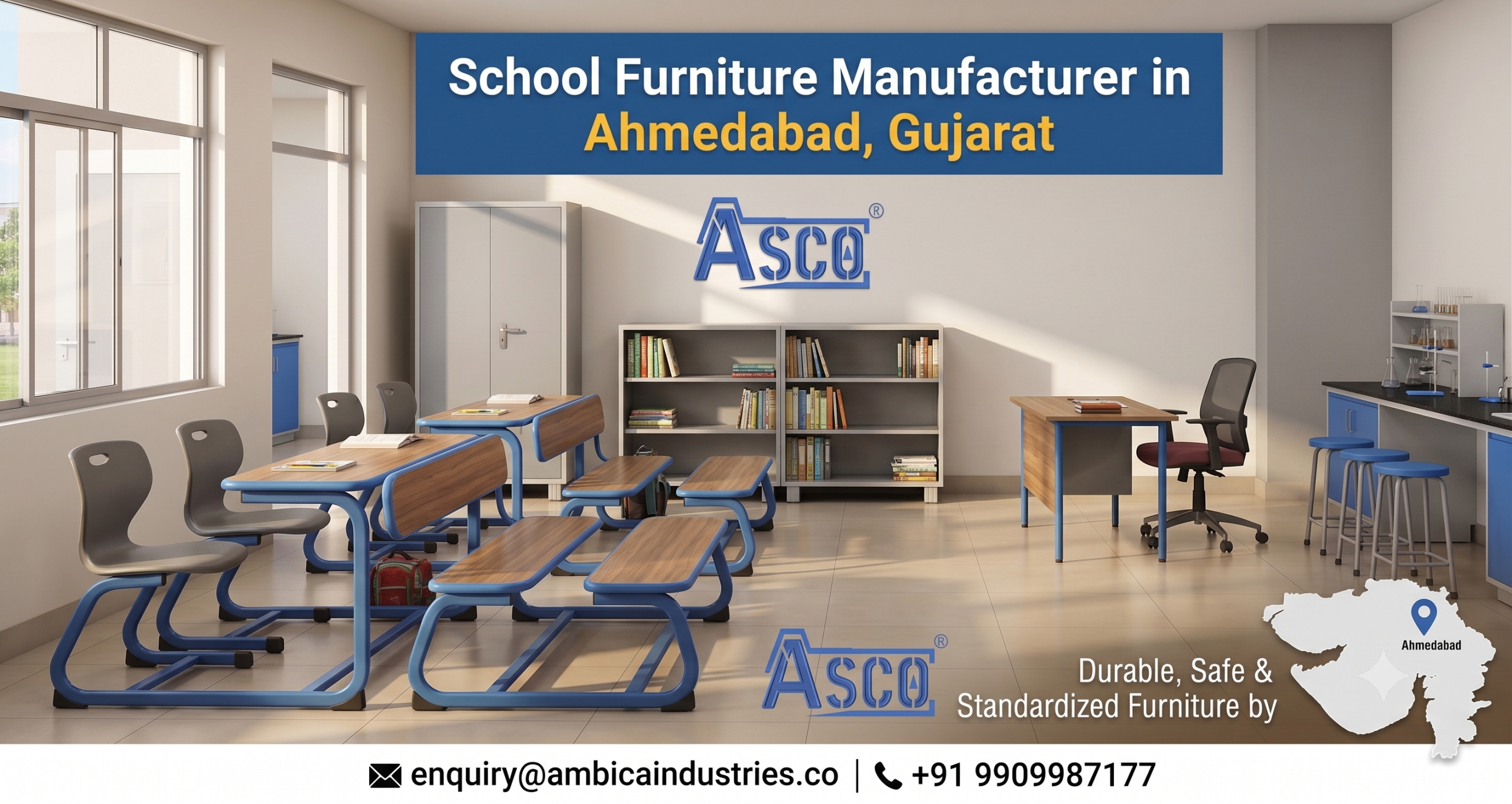
School Furniture Manufacturer in Ahmedabad, Gujarat: Complete Guide to Choosing the Best School Furniture for Educational Institutions
By ASCO® — Furniture Manufacturer, Ambica Industries, Narol, Ahmedabad
Introduction: Choosing the Right School Furniture Manufacturer in Ahmedabad
Choosing the right school furniture manufacturer in Ahmedabad is one of the most important infrastructure decisions a school, college, coaching institute or educational trust will make. Furniture is not a one-time purchase that sits quietly in the background — it is used every single day by students, teachers and staff, in classrooms, laboratories, libraries, staffrooms, hostels and administrative offices.
The right school furniture affects posture, concentration, safety, classroom organization, storage and the overall durability of a school’s infrastructure investment. Poorly built furniture, on the other hand, becomes a recurring maintenance headache — wobbling desks, broken hinges, cracked laminate and unstable benches that need replacement within a few years.
A typical school project may require a combination of:
- Student desks and benches
- Classroom chairs
- Single and dual desks
- Teacher’s tables and chairs
- Staffroom furniture
- Library tables, chairs and racks
- Laboratory tables and stools
- Computer lab workstations
- Storage cupboards and lockers
- Bookshelves and racks
- Auditorium and assembly seating
- Hostel beds and storage
- Administrative office furniture
This is why school administrators, trustees and procurement teams searching for a school furniture manufacturer near me, school furniture supplier in Ahmedabad, school furniture showroom in Ahmedabad, school furniture shop near me or school furniture store in Ahmedabad should compare more than just the sticker price.
The right furniture partner should understand institutional durability requirements, student safety, bulk manufacturing capacity, standardized dimensions across classrooms, and budget-conscious procurement — all at once.
ASCO® by Ambica Industries is an Ahmedabad-based furniture manufacturer with steel and wooden furniture manufacturing experience spanning over 19 years, serving office, institutional, commercial and school-furniture requirements. For schools in Ahmedabad and across Gujarat, the goal should be to find a manufacturer that can provide durable, safe, standardized and budget-appropriate school furniture, rather than simply the cheapest option nearby.
What Is School Furniture?
School furniture refers to the furniture products used inside educational institutions to support teaching, learning, administration and student welfare. Depending on the size and type of the institution, school furniture can include:
- Student desks (single, dual and multi-seater)
- School benches
- Classroom chairs
- Teacher’s desks and chairs
- Staffroom tables and lockers
- Library tables, reading chairs and book racks
- Laboratory workbenches and stools
- Computer lab workstations
- Storage cupboards and steel almirahs
- Lockers for students and staff
- Auditorium and assembly-hall chairs
- Hostel beds, study tables and storage
- Reception and administration furniture
- Notice boards and display units
ASCO®’s manufacturing base covers steel and wooden furniture that can be configured for classroom, laboratory, library, staffroom and administrative requirements. The exact combination required depends on the type of institution — a preschool, primary school, secondary school, college or coaching institute each has a distinct furniture profile.
Why School Furniture Needs Proper Planning
School furniture should never be purchased classroom by classroom without an institution-wide plan. A furniture plan for a school should consider:
- Number of classrooms and students per classroom
- Age group and corresponding desk/chair heights
- Movement space between rows
- Storage requirements for books and bags
- Laboratory and library layout
- Electrical points for computer labs
- Existing infrastructure and flooring
- Budget allocation across categories
- Maintenance and cleaning routine
- Future expansion of classrooms or intake
For example, a dual desk-bench combination may look economical on paper but may not suit a classroom with a compact carpet area once movement space and fire-exit clearance are accounted for. Similarly, an institution planning to add sections in future years should standardize dimensions early so that later purchases match existing furniture.
The correct furniture choice is therefore always influenced by the number of students, the age group and the available classroom area, not just the catalogue price of a single desk.
School Furniture for Different Areas of an Institution
Classroom Furniture
The classroom is the core learning space of any school. Common classroom furniture includes:
- Student desks and benches
- Single-seater and dual-seater desks
- Classroom chairs
- Teacher’s table and chair
- Storage cupboard or shelf
- Notice board
- Bag racks
Classroom furniture should provide comfortable seating for the age group being taught, while preserving enough space for teachers to move between rows and for students to exit safely during drills or emergencies.
Laboratory Furniture
Laboratory furniture can include:
- Laboratory workbenches
- Lab stools
- Storage cabinets for equipment and chemicals
- Sink and utility counters
- Computer lab workstations and chairs
Laboratory furniture should be selected according to safety requirements, resistance to spills and stains, and the specific subject — a chemistry lab, biology lab, physics lab and computer lab each have different furniture and layout needs.
Library Furniture
Library furniture typically includes:
- Reading tables
- Library chairs
- Bookshelves and racks
- Periodical display units
- Librarian’s desk
- Storage cabinets
A well-planned library layout should allow adequate spacing between reading tables while maximizing shelf storage for the available floor area.
Staffroom and Administrative Furniture
Staffroom and office furniture can include:
- Staff tables and chairs
- Personal lockers
- Filing cabinets
- Reception desks
- Visitor chairs
- Storage cupboards for records
ASCO® currently manufactures office chairs, desks, workstations, height-adjustable desks and storage furniture that can be configured for staffroom and administrative use in a school environment.
Hostel Furniture
For institutions with residential facilities, hostel furniture can include:
- Beds
- Study tables
- Storage lockers
- Wardrobes
- Common-area seating
Auditorium and Assembly Furniture
Larger institutions may require:
- Auditorium chairs
- Foldable or stackable seating
- Stage furniture
- Assembly-hall benches
Which Material Is Best for School Furniture?
There is no single material that is universally best for every piece of school furniture. The correct material depends on:
- Product type (desk, bench, chair, storage)
- Age group using the furniture
- Expected daily usage intensity
- Maintenance capacity of the institution
- Budget
- Durability requirement
- Climate and humidity in Gujarat
| Material | Common School Applications | Key Characteristic |
|---|---|---|
| Mild Steel (MS) | Desk/bench frames, lockers, storage cupboards, chair frames | High structural strength, resists daily impact from student use |
| Plywood | Desk tops, bench tops, cabinet panels | Good structural performance, moisture resistance when properly laminated |
| Engineered Wood / MDF | Library furniture, staffroom tables, cabinets | Design flexibility, consistent dimensions, smooth finish |
| Solid Wood | Teacher’s tables, decorative library furniture | Natural appearance, substantial construction |
| Powder-Coated Steel | Chair frames, desk legs, lockers | Corrosion resistance, long-term colour retention |
| Laminate Finish | Desk and table tops | Scratch resistance, easy cleaning, ink and stain resistance |
For heavy daily use — the kind school furniture experiences from morning assembly to the last period — a steel frame with a plywood or laminated top is commonly preferred by institutions for classroom desks and benches, because it combines structural strength with a durable writing surface.
Which Wood Is Best for School Furniture?
Wood-based components in school furniture can use solid wood, plywood, engineered wood or blockboard, depending on the application.
When choosing wood-based school furniture, institutions should consider:
- Density and strength for daily impact
- Moisture resistance, especially in Gujarat’s humid monsoon months
- Surface finish and edge treatment (important for student safety — rounded, splinter-free edges)
- Thickness of the desk or bench top
- Hardware quality (screws, brackets, joints)
Desk and bench tops experience different stresses from a decorative library table. A dual-seater desk used by two students daily needs a thicker, more robust top than a staffroom side table. Institutions should ask the manufacturer to specify the actual board grade and thickness rather than assuming every wooden-looking desk uses the same material.
What Is the Best School Furniture for Daily Use?
The best school furniture for daily use combines durability, correct ergonomic height for the age group, and low maintenance. For classrooms, this typically means steel-framed desks and benches with a laminated top, contoured classroom chairs, and storage that can withstand repeated opening and closing by students. For laboratories, it means spill-resistant workbenches. For libraries, it means stable reading tables and chairs that can be used for hours without discomfort.
The right choice always depends on how intensively the furniture will actually be used through the school day.
What Is the Best School Furniture Under Budget?
The best budget school furniture balances upfront price with long-term durability. A very low-cost desk that needs replacement within two years is rarely economical for an institution purchasing in bulk. Schools can control costs by:
- Standardizing desk and bench dimensions across classrooms
- Choosing practical, low-maintenance finishes
- Avoiding unnecessary decorative elements
- Purchasing multiple furniture categories from one manufacturer
- Planning bulk orders ahead of the academic year
- Comparing manufacturers on total project cost, not per-unit price alone
For large school projects, a manufacturer can also propose suitable combinations that fit a defined per-classroom budget.
Which School Furniture Is Most Durable?
Durability depends on material, construction, hardware, finish and how intensively students use the furniture. A student desk needs strong joints because it absorbs constant impact from books, bags and daily movement. A classroom chair needs a durable frame because it is dragged across the floor repeatedly. A storage cupboard needs reliable hinges because it is opened multiple times a day.
The most durable school furniture is not one single category — it is furniture that has construction appropriate to its actual classroom use, manufactured with correctly gauged steel, properly seasoned wood-based boards, and rust-resistant hardware.
Where to Buy School Furniture Near Me?
Institutions searching for:
school furniture near me · school furniture manufacturer near me · school furniture supplier near me · school furniture showroom near me · school furniture shop near me · school furniture store near me
will find local manufacturers, showrooms and suppliers across Ahmedabad. For a small quantity purchase, a nearby shop may be convenient. For furnishing an entire school — multiple classrooms, a laboratory, a library and a staffroom — it is far more useful to evaluate whether the supplier can provide multiple furniture categories, consistent dimensions, bulk manufacturing capacity, delivery and installation, and after-sales service.
ASCO®’s showroom and manufacturing facility is located in Narol, Ahmedabad, allowing school administrators and procurement committees to physically inspect desks, benches, chairs and storage furniture before placing a bulk order.
Where to Buy School Furniture Online in India?
School furniture can be researched through manufacturer websites, institutional furniture catalogues and B2B platforms. Online research is useful for comparing styles, dimensions, product categories and approximate pricing. However, schools should verify actual specifications — steel gauge, board thickness, finish and warranty — before finalizing a bulk order, since photographs alone cannot confirm structural quality.
Where Can I Find Cheap School Furniture?
Affordable school furniture is best found by comparing the total cost of a bulk order — furniture price, transportation, installation and expected replacement cycle — rather than comparing a single desk’s price across vendors. A desk that costs less initially but needs replacement within two academic years is rarely the more economical choice for a school managing dozens or hundreds of units.
When Should I Replace My School Furniture?
School furniture should be considered for replacement when it becomes:
- Structurally unstable or unsafe for students
- Difficult or costly to repair
- Visibly deteriorated (rust, splinters, broken laminate)
- Unsuitable for the current student age group or class strength
- Inconsistent with newly added classroom furniture
Replacement is also commonly planned alongside new classroom additions, campus expansion, or a shift from wooden to steel-and-plywood furniture for improved durability.
When Is the Right Time to Buy School Furniture?
The right time to buy school furniture is generally before the start of the academic session, allowing enough lead time for bulk manufacturing, delivery and installation across all classrooms. For a new school building, furniture should be planned alongside the final interior layout so that classroom dimensions, electrical points and storage areas are coordinated in advance.
Why Is School Furniture So Expensive?
School furniture pricing can vary because of differences in steel gauge, board material, hardware quality, finish, dimensions and the quantity ordered. A dual-seater desk with a laminated top and powder-coated steel frame naturally costs more to manufacture than a basic single bench, because it involves more material and labour. Bulk institutional orders, however, often bring the effective per-unit cost down compared to retail purchase of individual pieces.
Why Does School Furniture Wobble or Squeak?
Wobbling or squeaking in classroom furniture is usually caused by loose screws, weak welded joints, uneven flooring, worn hardware or improper assembly. Given how frequently student desks and chairs are moved, joints can loosen faster than in typical household furniture. If wobbling is widespread across a batch, it is worth having the manufacturer inspect welding and joint quality rather than repeatedly tightening the same fasteners.
Who Makes the Best School Furniture in India?
There is no single manufacturer that is objectively best for every school and every furniture category. The right manufacturer depends on product requirement, material, quantity, customization, budget, delivery timeline and after-sales service. For institutions in Ahmedabad and Gujarat, a local manufacturer offers advantages in communication, showroom access and coordinated bulk delivery.
ASCO® by Ambica Industries is an Ahmedabad-based furniture manufacturer with steel and wooden furniture manufacturing experience across office, institutional and school-furniture categories.
Who Is a Reliable School Furniture Manufacturer?
A reliable school furniture manufacturer should provide clear product specifications, consistent construction across a bulk order, suitable and safe materials, transparent pricing, customization for different age groups, realistic delivery planning, installation support and a documented warranty. For large school orders, institutions can also request desk samples, finish samples and previous project references before committing.
Who Supplies School Furniture in Bulk?
Bulk school-furniture requirements typically come from:
- New school and college campuses
- Educational trusts and societies
- Government and private school expansion projects
- Coaching institutes
- Hostel and residential campus projects
A bulk supplier should be capable of maintaining consistent dimensions, materials, finishes and delivery schedules across hundreds of units — standardization is essential when furnishing multiple classrooms at once.
How to Check Quality of School Furniture Before Buying?
Check Construction
Inspect the frame, joints, welding and support structure of a sample desk or bench before approving a bulk order.
Check Surface Finish
Look for a consistent laminate or paint finish, smooth rounded edges (important for student safety) and no visible manufacturing defects.
Check Hardware
Test hinges on storage cupboards, locking mechanisms on lockers, and fasteners on desks and chairs.
Check Stability
Desks, benches, chairs and storage cupboards should remain stable during normal use, including when leaned on or moved.
Check Dimensions
Verify desk and chair heights against the intended student age group — ergonomic mismatch is one of the most common school furniture complaints.
Check Storage
For lockers and cupboards, inspect shelf strength, hinge quality, and door alignment.
How Long Does Good School Furniture Last?
There is no single lifespan for all school furniture — it depends on material, construction, daily usage intensity, maintenance and environment. A student desk used by 40+ students a day across an academic year experiences far more wear than a staffroom cabinet used occasionally. Well-built steel-and-plywood classroom furniture, properly maintained, can typically serve a school for many years across multiple student batches.
How Much Weight Can School Furniture Hold?
Weight capacity varies by product — a classroom chair, a dual desk, a storage locker and a laboratory bench each have different structural requirements. Where load capacity is important (for example, laboratory storage or library shelving holding heavy books), institutions should ask the manufacturer for product-specific load specifications rather than assuming uniform capacity across categories.
Is School Furniture Worth the Price?
Quality school furniture is generally worth the investment because it is used intensively, every school day, by every student passing through the institution. Furniture that provides durability, correct ergonomics, safety and easy maintenance reduces long-term replacement and repair costs — making it a better value over its working life than the cheapest available option.
Is Steel or Wood Better for School Furniture?
Neither material is universally better — each suits different school furniture categories.
| Use Case | Better Suited Material | Reason |
|---|---|---|
| Desk and bench frames | Steel | High-impact resistance for daily student use |
| Storage cupboards / lockers | Steel | Durability, security, resistance to daily handling |
| Desk and table tops | Plywood / laminate | Smooth writing surface, moisture resistance |
| Library and staffroom furniture | Engineered wood / solid wood | Appearance, comfort for extended use |
Most institutional-grade school furniture today combines a steel frame with a wood-based top — a practical balance between durability and functional comfort.
Is Imported School Furniture Better Than Local School Furniture?
Imported school furniture is not automatically better than locally manufactured furniture. Local manufacturers can offer easier communication, faster bulk customization, local showroom and factory access, quicker delivery for large orders, and easier after-sales service — all of which matter significantly for a school managing furniture across dozens of classrooms. Institutions should compare actual material, construction, finish and service rather than assuming quality based on origin alone.
What Is the Difference Between Cheap and Quality School Furniture?
The difference typically shows up in steel gauge and welding quality, board thickness, hardware quality, surface finish, edge safety treatment, joint strength and overall stability under repeated daily use. Two desks can look nearly identical in a catalogue photo but perform very differently after a full academic year of student use. Institutions should compare specification against specification, not price against price.
What Is the Warranty Period for School Furniture?
Warranty periods vary by manufacturer, product category and the terms of the specific bulk order. Before finalizing a purchase, schools should obtain written warranty details and confirm whether the warranty covers the frame structure, hardware, laminate/finish and manufacturing defects.
Which Brand Is Most Reliable for School Furniture?
There is no universal brand ranking that applies to every institution. Reliability should be evaluated through manufacturing capability, material quality, construction, product range, customization for age groups, bulk delivery capacity and after-sales service. ASCO® by Ambica Industries is one Ahmedabad-based option institutions can evaluate for classroom, laboratory, library and staffroom furniture requirements.
What Is the Best School Furniture for Office Use?
For a school’s administrative office and staffroom, useful furniture includes ergonomic office chairs, staff desks, storage cabinets, filing cabinets and reception furniture. ASCO®’s office furniture range — chairs, desks, workstations and storage — can be configured for a school’s administrative and staffroom areas alongside its classroom furniture, allowing a single manufacturer to cover both requirements.
What Is the Best School Furniture for Home Use?
Some school-style furniture — particularly study desks, chairs and compact storage — is also purchased by parents for home study setups. For home use, a scaled-down version of institutional study furniture (a sturdy study table, an ergonomic chair sized for the child, and compact book storage) works well, following the same durability and ergonomic principles used in classroom furniture design.
How to Maintain School Furniture for Long Life?
- Clean surfaces regularly using methods appropriate for laminate, wood or steel finishes.
- Check hardware periodically — hinges, screws, drawer channels and locks on lockers and cupboards.
- Avoid excessive loads on shelves, drawers and storage units.
- Repair minor damage early — a loose joint left unattended becomes a larger structural issue.
- Inspect installation — unstable desks or benches should be corrected promptly for student safety.
- Protect finishes from excessive moisture during Gujarat’s monsoon season.
Is School Furniture Available on the Government e-Marketplace Portal?
Institutional and government procurement in India often takes place through official government e-marketplace channels alongside direct manufacturer procurement, tenders and empanelled supplier lists. Availability, seller status and product listings on any particular e-marketplace platform can change over time, so schools and procurement committees are advised to verify current listing status and product categories directly with the manufacturer at the time of purchase, rather than assuming availability. Direct procurement from the manufacturer’s showroom, website or sales team remains a reliable route for schools that want to confirm specifications, pricing and delivery timelines in real time.
What Is the Price Range for School Furniture in India?
There is no single price range for school furniture because the category spans many products — from a basic classroom chair to a fully equipped computer lab workstation. Pricing depends on furniture type, dimensions, material, finish, hardware, quantity and delivery location. For an accurate institutional quotation, schools should provide a full furniture list, quantity per category, dimensions, material preference, delivery location and installation requirements.
Which School Furniture Is Best for Small Space?
Schools with compact classrooms or limited floor area benefit from space-efficient furniture such as:
- Compact single-seater desks
- Stackable or foldable chairs
- Wall-mounted or vertical storage
- Combined desk-and-storage units
- Slim library shelving
- Multi-purpose tables for shared use
Customized dimensions can be especially useful for institutions with irregularly shaped classrooms or restricted floor space.
School Furniture for New Schools
A new school should be furnished based on the full campus floor plan. A practical process typically follows:
Floor plan → classroom count and student strength → furniture selection → dimensions per age group → material and finish → quotation → bulk production → delivery → installation.
Planning furniture requirements before the building’s interior fit-out helps avoid mismatches with doorways, storage areas, electrical points and classroom circulation space.
School Furniture for Preschools and Primary Sections
Preschool and primary-section furniture requires special attention to scaled-down dimensions, rounded safety edges, lightweight but sturdy construction, and bright, durable finishes suited to younger children.
School Furniture for Secondary Schools and Colleges
Secondary schools and colleges typically require larger dual or multi-seater desks, laboratory furniture for science subjects, computer lab workstations and library furniture suited to longer study sessions.
School Furniture for Hostels and Residential Campuses
Residential campuses need beds, study tables, personal storage lockers and common-area seating that can withstand round-the-clock daily use beyond regular classroom hours.
School Furniture for Trusts, Builders and Institutional Projects
Educational trusts, builders developing school campuses, and institutional project consultants often require school furniture in bulk. Such projects require standardized dimensions, consistent materials and finishes, production planning aligned to construction timelines, and coordinated delivery and installation — an area where working directly with a manufacturer is particularly useful.
School Furniture Showroom in Ahmedabad: What Should You Check?
A showroom visit allows school administrators to see and test furniture before committing to a bulk order. When visiting, inspect product construction, seating comfort, dimensions, materials, finish, hardware and overall stability. For desks and benches, checking multiple sample units — not just one — helps confirm manufacturing consistency.
School Furniture Factory in Ahmedabad: Why Visit?
A factory visit provides additional insight into production capacity, manufacturing process, material handling, machinery, finishing quality and dispatch readiness — information that is especially useful for large bulk orders that a retail shop visit alone cannot provide. ASCO®’s manufacturing facility and showroom in Narol, Ahmedabad, is available for institutional buyers to visit and evaluate before placing bulk orders.
Customized School Furniture in Ahmedabad
Not every institution has standard classroom dimensions or a single age group. Customization can be useful for:
- Desk and bench height by age group
- Storage configuration for lockers and cupboards
- Colour and finish matching institutional branding
- Laboratory bench layout
- Library shelving dimensions
For larger projects, institutions should provide accurate classroom measurements and student-strength data before production begins.
School Furniture Supplier in Gujarat
School-furniture buyers across Gujarat may be located in Ahmedabad, Gandhinagar, Vadodara, Surat, Rajkot, Bharuch, Ankleshwar, Vapi, Mehsana, Anand, Nadiad, Bhavnagar, Jamnagar and Junagadh. Each district’s institutions can have different requirements based on school size, student strength and project scale. An Ahmedabad-based manufacturer is well positioned to serve local production, customization and coordinated bulk delivery across Gujarat.
Bulk School Furniture Supplier in Gujarat
Bulk school-furniture orders are commonly required by educational trusts, school-building developers, government and private school expansion projects, and coaching-institute chains. For bulk orders, institutions should confirm quantity, production capacity, material specification, finish, delivery schedule, installation support and warranty terms. Standardizing specifications across all classrooms significantly simplifies multi-classroom procurement.
School Furniture Demand Across Gujarat’s Districts
Gujarat’s education sector spans a wide range of institution types — from large CBSE and state-board schools in metro areas to smaller rural and semi-urban schools across the state’s districts. Each region presents a slightly different procurement pattern:
- Ahmedabad and Gandhinagar — the state’s largest concentration of private schools, CBSE/ICSE institutions and coaching centres, with frequent new-campus and expansion projects.
- Vadodara — a mix of established schools and newer residential-area institutions requiring both replacement and bulk new orders.
- Surat — rapid urban growth has driven demand for new school campuses and standardized bulk furniture orders.
- Rajkot, Bhavnagar and Jamnagar — Saurashtra region institutions, often requiring durable, low-maintenance furniture suited to a wide seasonal temperature range.
- Bharuch, Ankleshwar and Vapi — industrial-belt towns with growing residential populations and corresponding school infrastructure needs.
- Mehsana, Anand and Nadiad — semi-urban and rural institutions that often prioritize budget-conscious, durable furniture for long-term use.
- Junagadh and surrounding Saurashtra towns — institutions that benefit from centralized bulk manufacturing and coordinated delivery, given more limited local manufacturing options.
An Ahmedabad-based manufacturer with in-house production capacity is well placed to serve this entire state-wide footprint through coordinated dispatch and installation planning.
Government vs Private School Furniture Requirements
Government and private school procurement patterns often differ, and understanding these differences helps a manufacturer propose the right specification:
| Factor | Government / Aided Schools | Private / Trust Schools |
|---|---|---|
| Typical priority | Cost-efficiency at scale, standardized specification | Balance of durability, appearance and budget |
| Procurement process | Formal tendering, empanelment or e-marketplace channels | Direct manufacturer quotation and negotiation |
| Customization | Limited — standardized specifications across many schools | Higher — branding, colour and layout customization common |
| Order size | Often very large, multi-school orders | Ranges from single-campus to multi-branch orders |
| Delivery timeline | Tied to academic-year budget cycles | Tied to admission season and campus readiness |
Both categories benefit from working with a manufacturer capable of handling bulk institutional volumes while maintaining consistent quality control across every unit produced.
School Furniture Supply Beyond Gujarat
While ASCO® is based in Ahmedabad, institutional buyers evaluating a manufacturer for a multi-state school network should also confirm the manufacturer’s capability to coordinate delivery and installation for campuses outside Gujarat. Institutions with branches across multiple states benefit from a single manufacturing partner that can maintain consistent specification, finish and quality across every branch, rather than sourcing furniture separately for each location.
Sustainability Considerations in School Furniture
Sustainability is an increasingly relevant factor for schools reviewing their procurement policies. Considerations can include:
- Choosing furniture with a long working life to reduce replacement frequency and material waste
- Selecting engineered wood and plywood sourced from responsibly managed suppliers
- Preferring recyclable steel components in desk and bench frames
- Working with a manufacturer that can repair and refurbish existing furniture rather than requiring full replacement
A durable, well-constructed desk or bench that serves a school for many years is inherently a more sustainable choice than furniture that requires replacement every one or two academic sessions.
How to Compare School Furniture Manufacturers
| Factor | What to Check |
|---|---|
| Manufacturing | Does the company manufacture in-house or mainly resell? |
| Product range | Can classroom, lab, library and staffroom furniture all be supplied? |
| Materials | Are steel gauge and board specifications clearly stated? |
| Quality | Can a sample unit be inspected before bulk order? |
| Customization | Can dimensions be adjusted for age group? |
| Bulk capacity | Can the manufacturer handle a full-campus order on schedule? |
| Delivery | Is the proposed schedule realistic before session start? |
| Installation | Is on-site installation available? |
| Warranty | Are terms documented in writing? |
| Service | Is after-sales support available for repairs and replacement parts? |
How to Get a School Furniture Quotation
Project Details
- Institution type and location
- New campus or replacement order
- Project timeline before academic session
Furniture Details
- Product list (desks, benches, chairs, storage, lab/library furniture)
- Quantity per category
- Dimensions per age group
- Material and finish preference
Technical Details
- Classroom floor plan
- Room measurements
- Door and storage-area locations
- Electrical points for computer labs
Commercial Details
- Delivery location
- Installation requirement
- Required completion date
- Number of classrooms/campuses
The more complete this information, the more accurate the manufacturer’s institutional quotation will be.
School Furniture Buying Checklist
| Category | Checklist Items |
|---|---|
| Product | Correct product, quantity, dimensions, material, finish, colour |
| Quality | Sample approved, hardware checked, construction checked, finish approved |
| Project | Classroom measurements confirmed, layout approved, delivery and installation schedule confirmed |
| Commercial | Final quotation, transportation, installation, payment terms, warranty |
| Service | Warranty documented, service contact confirmed, replacement procedure understood |
How ASCO® by Ambica Industries Fits School Furniture Requirements
ASCO® is the furniture brand of Ambica Industries, an Ahmedabad-based furniture manufacturer with over 19 years of manufacturing experience across steel and wooden furniture for office, institutional, commercial and school-furniture requirements. The brand follows a “Quality within budget” approach that is particularly relevant for schools managing large bulk procurement within fixed infrastructure budgets.
For institutions, this broader manufacturing range can be useful when several furniture categories — classroom desks, staffroom furniture, library racks and storage lockers — need to be sourced together rather than from unrelated suppliers.
A typical school project may combine:
- Student desks and benches
- Classroom chairs
- Teacher and staff furniture
- Library and laboratory furniture
- Storage cupboards and lockers
Working with a single furniture manufacturer can simplify communication, specification consistency and delivery coordination for the entire school project.
Institutions can Explore ASCO® Furniture Products Contact Ambica Industries
For seating requirements specifically, buyers can also review the ASCO® chair range. The published contact page identifies Ambica Industries at Narol, Ahmedabad, Gujarat.
School Furniture Manufacturer in Ahmedabad for Gujarat Projects
Ahmedabad is an important manufacturing and commercial centre in Gujarat. A local school-furniture manufacturer offers advantages for institutions that value factory communication, local showroom access, customization for different age groups, coordinated bulk delivery and ongoing service. School furniture demand comes not only from individual schools but also from educational trusts, builders, architects designing school campuses, and government project consultants. For projects outside Ahmedabad, institutions should confirm transportation and installation coverage before ordering.
How to Choose Furniture for a Complete School Campus
A complete school campus should be planned area by area:
Classrooms
Start with desks, benches, chairs and teacher furniture, standardized by age group.
Laboratories
Plan workbenches, stools and safe storage for equipment.
Library
Plan reading tables, chairs and shelving proportional to the collection size.
Staffroom and Administration
Plan staff desks, chairs, storage and reception furniture.
Hostel (if applicable)
Plan beds, study furniture and personal storage.
This approach prevents one area of the campus from being over-furnished while another remains under-equipped.
Glossary of School Furniture Terms
| Term | Meaning |
|---|---|
| MS Frame | Mild steel frame — the structural base used in most institutional desks, benches and chairs. |
| Powder Coating | An electrostatically applied dry-paint finish baked onto steel for corrosion resistance and colour retention. |
| Laminate Top | A high-pressure or low-pressure decorative layer bonded to a board top for scratch and stain resistance. |
| Board Grade | The classification of plywood, MDF or particle board by density, glue type and moisture resistance. |
| Gauge (Steel) | A measurement of steel sheet thickness — lower gauge numbers indicate thicker, stronger steel. |
| Ergonomic Height | The seat and desk height matched to a specific student age band for correct posture. |
| Modular Furniture | Furniture designed to be reconfigured, stacked or combined in different classroom layouts. |
| BOQ (Bill of Quantities) | An itemized list of furniture products and quantities used for institutional quotation and procurement. |
A Step-by-Step School Furniture Procurement Timeline
- Needs assessment (8–10 weeks before session start) — count classrooms, student strength per section, and identify age-wise furniture requirements across classrooms, labs, library and staffroom.
- Manufacturer shortlisting (7–8 weeks before) — compare manufacturers on the factors outlined earlier in this guide, and request sample units from top candidates.
- Sample approval (6–7 weeks before) — physically test sample desks, chairs and storage units for stability, comfort and finish quality.
- Quotation and BOQ finalization (5–6 weeks before) — confirm final specifications, quantities, pricing, delivery and installation terms in writing.
- Production (3–5 weeks, depending on order size) — bulk manufacturing begins once the order is confirmed; larger orders require longer lead times.
- Delivery and installation (1–2 weeks before session start) — furniture is delivered classroom by classroom and installed, with a final walkthrough to confirm quantities and condition.
- Post-installation inspection — a final quality check across all classrooms before students occupy the space, with any defects flagged for immediate correction under warranty.
Institutions that begin this process well ahead of the academic calendar avoid the common last-minute scramble that leads to compromises on quality, specification or budget.
The Case for Standardization Across a School Campus
Standardizing furniture dimensions, materials and finishes across an entire campus — rather than ordering different specifications for each classroom over time — offers several practical advantages:
- Simplified maintenance — spare parts, replacement components and repair techniques remain consistent across the campus.
- Predictable budgeting — future expansion or replacement orders can be quoted against known specifications rather than requiring a fresh evaluation each time.
- Visual consistency — a uniform look across classrooms supports a more organized, professional campus appearance.
- Simplified inventory management — administrative staff can track furniture counts and condition more easily when categories are standardized.
Schools planning phased expansion — adding new classrooms or sections over several years — benefit particularly from locking in a standard specification with their chosen manufacturer early, so that later orders can match seamlessly.
School Furniture Trends for Modern Indian Institutions
- Modular and stackable classroom seating for flexible room layouts
- Combined desk-and-storage units to save floor space
- Ergonomically contoured chairs for extended sitting comfort
- Computer-lab workstations designed for cable management
- Space-efficient library shelving
- Durable powder-coated finishes for long-term appearance retention
Space-Saving School Furniture
Space-saving school furniture is especially useful for institutions operating in compact urban buildings. Solutions include stackable chairs, foldable desks, vertical storage lockers, slim library shelving and combined desk-storage units — all of which should be measured against actual classroom dimensions before ordering in bulk.
Age-Wise Desk and Chair Dimensions: Why Ergonomics Matter
One of the most overlooked aspects of school furniture procurement is ergonomic fit. A desk and chair combination that suits a Class 8 student will be entirely unsuitable for a Class 1 student, and vice versa. Mismatched furniture height is directly linked to poor posture, fatigue, difficulty concentrating and long-term musculoskeletal strain in growing children. A responsible school furniture manufacturer will offer a graded range of desk and chair heights matched to standard age bands rather than a single “one size fits all” product.
| Age Group / Class Level | Typical Seat Height Range | Typical Desk Height Range |
|---|---|---|
| Pre-primary / Nursery (3–5 yrs) | 26–30 cm | 46–52 cm |
| Primary (Class 1–4) | 30–35 cm | 52–58 cm |
| Upper Primary (Class 5–7) | 35–40 cm | 58–64 cm |
| Secondary (Class 8–10) | 40–44 cm | 64–70 cm |
| Senior Secondary / College | 44–46 cm | 70–76 cm |
These ranges are indicative and should always be confirmed against the specific product specification sheet of the manufacturer, since designs can vary slightly between models. A school with mixed-age classrooms, or a school planning multi-year use of the same furniture batch, should discuss height-adjustable or modular options with the manufacturer rather than assuming a single dimension will work across all sections.
Types of School Desks Explained
Single-Seater Desks
Single-seater desks are increasingly preferred in modern classrooms because they allow flexible seating arrangements, easier social distancing when required, and simpler individual replacement if one unit is damaged.
Dual-Seater Desks
Dual-seater desk-and-bench combinations remain common in Indian schools because they use classroom floor space efficiently and are cost-effective for large student strength per classroom.
Multi-Seater Benches
Multi-seater desk-bench units (three or more students) are typically used in government and budget-constrained institutional settings where floor space and per-unit cost are the primary considerations.
Foldable and Stackable Desks
Foldable and stackable designs are useful for multipurpose halls, exam halls, and classrooms that need to be reconfigured for different activities or reduced to create open floor space for events.
Computer Lab Workstation Desks
Computer lab desks require additional design consideration: cable management channels, adequate depth for monitors and CPUs, and surface material that resists scratches from repeated equipment placement.
Classroom Chair Types Explained
- Fixed classroom chairs — simple, durable, cost-effective for standard classrooms.
- Chairs with book/bag storage — a small under-seat rack that keeps bags off the floor and aisle space clear.
- Stackable chairs — useful for assembly halls, exam halls and multipurpose rooms that need quick reconfiguration.
- Writing-pad (tablet-arm) chairs — a chair with an attached writing surface, useful for coaching institutes and lecture-style seating.
- Ergonomic contoured chairs — moulded seat and backrest shape designed for extended sitting comfort during long school days.
Storage and Locker Systems Explained
Storage is one of the most functionally important — and most frequently underplanned — categories of school furniture. Poorly planned storage leads to cluttered classrooms, bags left on the floor, and difficulty maintaining an organized learning environment. Common storage categories include:
- Student lockers — individual or shared compartments for books, bags and personal items, commonly used in secondary schools and colleges.
- Classroom storage cupboards — shared storage for teaching aids, stationery and classroom materials.
- Library racks and shelving — sized to the book collection, with adjustable shelving preferred for flexibility as the collection grows.
- Laboratory storage cabinets — built to safely store equipment, glassware and, where applicable, chemicals, with appropriate ventilation and locking.
- Staff and administrative filing cabinets — for records, documentation and administrative files.
Steel storage furniture is generally preferred over wood-based storage in Indian institutional settings because of its resistance to termites, moisture and daily wear — a particularly relevant consideration in Gujarat’s humid monsoon months.
Colour, Finish and Institutional Branding Customization
Many schools prefer to align furniture colour schemes with their institutional branding or house-colour system. A manufacturer offering a range of powder-coat colours and laminate finishes allows a school to maintain visual consistency across classrooms while still choosing durable, easy-to-clean surfaces. Common considerations include:
- Matching desk and chair colours to the school’s branding or house colours
- Choosing scratch- and stain-resistant laminate finishes for high-traffic classroom furniture
- Selecting anti-corrosive powder-coated steel finishes for long-term appearance retention
- Coordinating storage and locker colours with classroom furniture for a unified campus appearance
Safety Considerations in School Furniture Design
Student safety should be a non-negotiable factor in furniture selection, particularly for younger age groups. Key safety considerations include:
- Rounded, splinter-free edges on all desks, benches and tables to prevent injury during normal classroom movement.
- Stable base construction that resists tipping, especially for chairs and taller storage units.
- Non-toxic, low-VOC finishes appropriate for enclosed classroom environments used by children for many hours daily.
- Secure hardware — screws, bolts and brackets that do not loosen or protrude with regular use.
- Fire-safety-conscious classroom layout — furniture arrangement that preserves clear aisle space and emergency exit routes.
- Anti-tip design for storage cupboards and lockers, particularly in classrooms used by younger children.
Schools evaluating a new furniture manufacturer should specifically ask about edge-finishing methods, hardware quality and any internal quality checks performed before dispatch.
Common Mistakes Schools Make When Buying Furniture
- Buying on price alone without comparing steel gauge, board thickness or hardware quality — leading to early replacement costs.
- Ordering a single dimension for all age groups, resulting in ergonomic mismatch for younger or older students.
- Skipping the sample-approval step before a large bulk order is manufactured.
- Not confirming delivery and installation timelines against the academic calendar, leading to classrooms without furniture at session start.
- Overlooking storage planning, resulting in cluttered classrooms even after new desks and chairs are installed.
- Not documenting warranty terms in writing before finalizing payment.
Seasonal Maintenance for Gujarat’s Climate
Ahmedabad and the wider Gujarat region experience a distinct hot, dry summer followed by a humid monsoon season — both of which affect furniture differently.
During the Monsoon (June–September)
- Wipe down furniture surfaces to remove humidity-related condensation.
- Check wood-based furniture for early signs of swelling around joints and edges.
- Ensure storage cupboards and lockers are ventilated to prevent musty odour build-up.
- Inspect steel furniture for early rust spots, particularly on exposed frame joints.
During Summer (March–June)
- Avoid placing wood-finish furniture in direct, prolonged sun exposure through unshaded windows, which can cause finish fading.
- Check that laminate surfaces have not developed heat-related lifting at the edges.
Institutions that plan a light maintenance check at the start of each term — before the academic session and again after the monsoon — typically extend the working life of their furniture significantly compared to reactive, complaint-driven maintenance.
Illustrative Furniture Planning Scenarios
Scenario: A New CBSE School Opening With 12 Classrooms
A new school typically needs to plan desks and benches for each grade band, teacher furniture per classroom, a staffroom furniture set, a small library setup and administrative office furniture — all delivered and installed before the admission session begins. Standardizing dimensions per grade band across all 12 classrooms from day one avoids mismatched furniture in later expansion phases.
Scenario: An Existing School Replacing Worn-Out Benches
A school replacing furniture after several years of use should first audit which classrooms have the most worn or unsafe furniture, prioritize replacement there, and use the opportunity to correct any long-standing ergonomic mismatches rather than simply reordering the same old dimensions.
Scenario: A Coaching Institute Setting Up a New Centre
Coaching institutes often prioritize writing-pad chairs or compact desks for space efficiency, since classroom sizes tend to be smaller and student turnover between batches is higher than in a full-day school.
Frequently Asked Questions About School Furniture
1. What is the best School Furniture for daily use?
The best school furniture for daily use combines durable construction, correct ergonomic height for the student age group, and low-maintenance finishes — typically steel-framed desks and benches with a laminated top, and contoured classroom chairs.
2. What is the best School Furniture under budget?
The best budget school furniture balances price with durability and functionality. Standardized dimensions, practical finishes and bulk purchasing from a single manufacturer help control the total project cost.
3. Which School Furniture is most durable?
Durability depends on material, construction, hardware and daily usage intensity. A well-built steel-framed desk, bench, chair or storage locker with correctly gauged steel and quality hardware can provide long-term institutional service.
4. Which material is best for School Furniture?
There is no single best material for every product. Steel is commonly preferred for desk and bench frames, storage and lockers, while plywood, laminate and engineered wood are commonly used for tops, library furniture and staffroom furniture.
5. Which wood is best for School Furniture?
The appropriate wood-based material depends on the product — solid wood, plywood, engineered wood and blockboard each have different applications. Institutions should compare board grade, thickness, moisture resistance and finish.
6. Where to buy School Furniture near me?
Search for a school furniture manufacturer, supplier, showroom, store or shop near your institution’s location. For Ahmedabad-based schools, a local manufacturer and showroom allow physical inspection and discussion of bulk customization.
7. Where to buy School Furniture online in India?
School furniture can be researched through manufacturer websites and institutional furniture catalogues. Before finalizing a bulk order, verify dimensions, material, warranty, delivery and installation directly with the manufacturer.
8. Where can I find cheap School Furniture?
Affordable school furniture is best found by comparing total project cost across manufacturers — including transportation and installation — rather than comparing a single unit’s price alone. Bulk purchasing typically improves overall value.
9. When should I replace my School Furniture?
School furniture should be considered for replacement when it becomes structurally unstable, unsafe, difficult to repair economically, visibly deteriorated, or unsuitable for the current student age group or class strength.
10. When is the right time to buy School Furniture?
The right time to buy is generally before the start of the academic session, allowing sufficient lead time for bulk manufacturing, delivery and installation across all classrooms.
11. Why is School Furniture so expensive?
Costs vary based on steel gauge, board material, hardware quality, finish, dimensions and order quantity. Bulk institutional orders can bring the effective per-unit cost down compared to individual retail purchase.
12. Why does School Furniture wobble or squeak?
Wobbling or squeaking is typically caused by loose fasteners, weak joints, uneven flooring, worn hardware or improper assembly — common given how frequently classroom furniture is moved by students.
13. Who makes the best School Furniture in India?
There is no universal manufacturer that is best for every institution. Buyers should compare manufacturers on material quality, construction, customization, bulk capacity, delivery timeline and after-sales service.
14. Who is a reliable School Furniture manufacturer?
A reliable manufacturer provides clear specifications, consistent quality across bulk orders, transparent pricing, customization for age groups, realistic delivery planning, installation support and a documented warranty.
15. Who supplies School Furniture in bulk?
Bulk school furniture is typically supplied by institutional furniture manufacturers to schools, educational trusts, builders and coaching-institute projects. Production capacity and dimensional consistency should be confirmed before ordering.
16. How to check quality of School Furniture before buying?
Inspect construction, joints, welding, hardware, surface finish, dimensions and overall stability. Request one finished sample unit before approving a bulk manufacturing order.
17. How long does a good School Furniture last?
Useful life depends on material, construction, daily usage intensity, maintenance and environment. Well-built steel-and-plywood classroom furniture can serve a school across multiple student batches when properly maintained.
18. How much weight can a School Furniture hold?
Weight capacity varies by product — desks, benches, chairs, lockers and library shelving each have different structural requirements. Ask the manufacturer for product-specific load-bearing specifications where relevant.
19. Is School Furniture worth the price?
Quality school furniture is generally worth the investment because of intensive daily use by every student in the institution. Durable, safe and low-maintenance furniture provides better long-term value than the cheapest available option.
20. Is steel or wood better for School Furniture?
Neither is universally better. Steel is well suited to desk frames, benches, lockers and storage, while wood-based materials suit tops, library furniture and staffroom furniture. Most classroom furniture combines both.
21. Is imported School Furniture better than local School Furniture?
Imported furniture is not automatically better. Local manufacturers offer easier communication, faster bulk customization, factory access, quicker delivery and easier after-sales service for large institutional orders.
22. What is the difference between cheap and quality School Furniture?
Differences typically appear in steel gauge, welding quality, board thickness, hardware, surface finish, edge safety treatment and joint strength. Specification comparison is more reliable than comparing price alone.
23. What is the warranty period for School Furniture?
Warranty periods vary by manufacturer, product and the specific institutional order agreement. Always obtain written warranty details before finalizing a bulk purchase.
24. Which brand is most reliable for School Furniture?
There is no universal brand ranking. Reliability should be assessed through manufacturing capability, material quality, customization, bulk delivery capacity, warranty and after-sales service.
25. What is the best School Furniture for office use?
For a school’s administrative office and staffroom, useful furniture includes ergonomic office chairs, staff desks, filing cabinets and reception furniture.
26. What is the best School Furniture for home use?
For home study setups, a scaled-down version of institutional study furniture — a sturdy desk, an appropriately sized chair and compact storage — follows the same durability and ergonomic principles as classroom furniture.
27. How to maintain School Furniture for long life?
Clean surfaces regularly, inspect hardware periodically, avoid excessive loads on storage units, repair minor damage early, check installation stability, and protect finishes from moisture, especially during the monsoon season.
28. Is School Furniture available on the government e-marketplace portal?
Government and institutional procurement in India can involve official e-marketplace channels alongside direct manufacturer procurement and tenders. Listing status can change over time, so schools should verify current availability directly with the manufacturer at the time of purchase.
29. What is the price range for School Furniture in India?
Prices vary by product type, dimensions, material, finish, hardware, quantity and delivery location. A complete furniture list with quantities and specifications is needed for an accurate institutional quotation.
30. Which School Furniture is best for small space?
Compact single-seater desks, stackable chairs, vertical storage lockers and slim library shelving work well in institutions with limited classroom floor area. Customized dimensions can further improve space utilization.
Internal Resources for School Furniture Buyers
- ASCO® Furniture Products — review current furniture categories including chairs, desks, storage and more.
- ASCO® Chair Range — explore seating products relevant to classrooms and staffrooms.
- ASCO® About Us — learn about Ambica Industries and the ASCO® furniture brand.
- Contact ASCO® — discuss furniture requirements, quantities and project details.
For general furniture product-safety and industry benchmarking information, institutions can also consult professional furniture-industry resources such as BIFMA where applicable to institutional seating and furniture specifications.
Final Conclusion: Choosing a School Furniture Manufacturer in Ahmedabad
Choosing school furniture is a long-term safety, durability and procurement decision — not simply a search for the lowest-priced desk. Whether an institution is searching for:
- School furniture manufacturer in Ahmedabad
- School furniture manufacturer in Gujarat
- School furniture supplier Ahmedabad
- School furniture factory Ahmedabad
- School furniture showroom Ahmedabad
- School furniture near me
- School furniture supplier near me
- School furniture manufacturer near me
- School furniture shop Ahmedabad
- School furniture store Ahmedabad
- Bulk school furniture supplier
- Customized school furniture manufacturer
the right furniture partner should be evaluated on product suitability, material, construction, dimensions per age group, durability, safety, customization, bulk quantity capability, delivery, installation, warranty and service.
ASCO® by Ambica Industries is an Ahmedabad-based furniture brand with over 19 years of manufacturing experience across steel and wooden furniture, covering classroom, laboratory, library, staffroom and administrative categories under a “Quality within budget” approach.
Institutions and procurement committees can Explore ASCO® Furniture Products Contact Ambica Industries, or visit the Narol, Ahmedabad showroom to evaluate school furniture in person before placing a bulk order.
The objective is not simply to find the cheapest school furniture — it is to select a manufacturing partner capable of supplying furniture that is safe, durable, correctly sized and suitable for the way students will actually use it every school day.